Options: Calls, Puts, and Basic Payoff Logic
How calls and puts work, how moneyness and premium are interpreted, and why buyer and writer risk differ sharply.
Options are among the most testable derivative contracts in the CSC because they combine clear legal rights with non-linear payoff patterns. Students must distinguish the buyer from the writer, the call from the put, and premium from payoff.
Once the structure is clear, option questions become much easier. Most mistakes happen because students reverse the contract right, confuse intrinsic value with premium, or forget that writers and buyers have very different risk profiles.
What an Option Is
An option gives its buyer a right, not an obligation, relating to an underlying asset at a stated exercise or strike price before or at expiry, depending on the contract style.
The buyer pays a premium for that right. The writer receives the premium and takes on the corresponding obligation if the option is exercised.
Calls and Puts
Call Option
A call gives the buyer the right to buy the underlying at the strike price.
The buyer of a call benefits when the underlying price rises.
Put Option
A put gives the buyer the right to sell the underlying at the strike price.
The buyer of a put benefits when the underlying price falls.
That direction logic is essential. A large share of option mistakes are simply call-versus-put mistakes.
Buyer Versus Writer
The option buyer and writer do not have the same risk profile.
- the buyer has limited loss, generally capped at the premium paid
- the writer receives premium up front but may face much larger risk if exercised
This is especially important for uncovered writing. Premium income may look attractive, but the obligation can become costly if the market moves sharply against the writer.
Premium, Intrinsic Value, and Time Value
Option premium can be broken conceptually into:
- intrinsic value
- time value
For a call:
For a put:
where:
- (S) is the current underlying price
- (K) is the strike price
Time value is the portion of premium above intrinsic value. It reflects remaining uncertainty and opportunity before expiry.
Moneyness
Students should be able to classify moneyness quickly.
Calls
- in the money: underlying price above strike
- at the money: underlying price near strike
- out of the money: underlying price below strike
Puts
- in the money: underlying price below strike
- at the money: underlying price near strike
- out of the money: underlying price above strike
Option Style and Expiry Logic
Students may also encounter the style distinction:
- American-style options can generally be exercised at any time up to expiry
- European-style options are generally exercisable only at expiry
The exam usually tests the concept rather than detailed trading conventions. The main point is that exercise rights can differ by contract style.
Payoff at Expiry
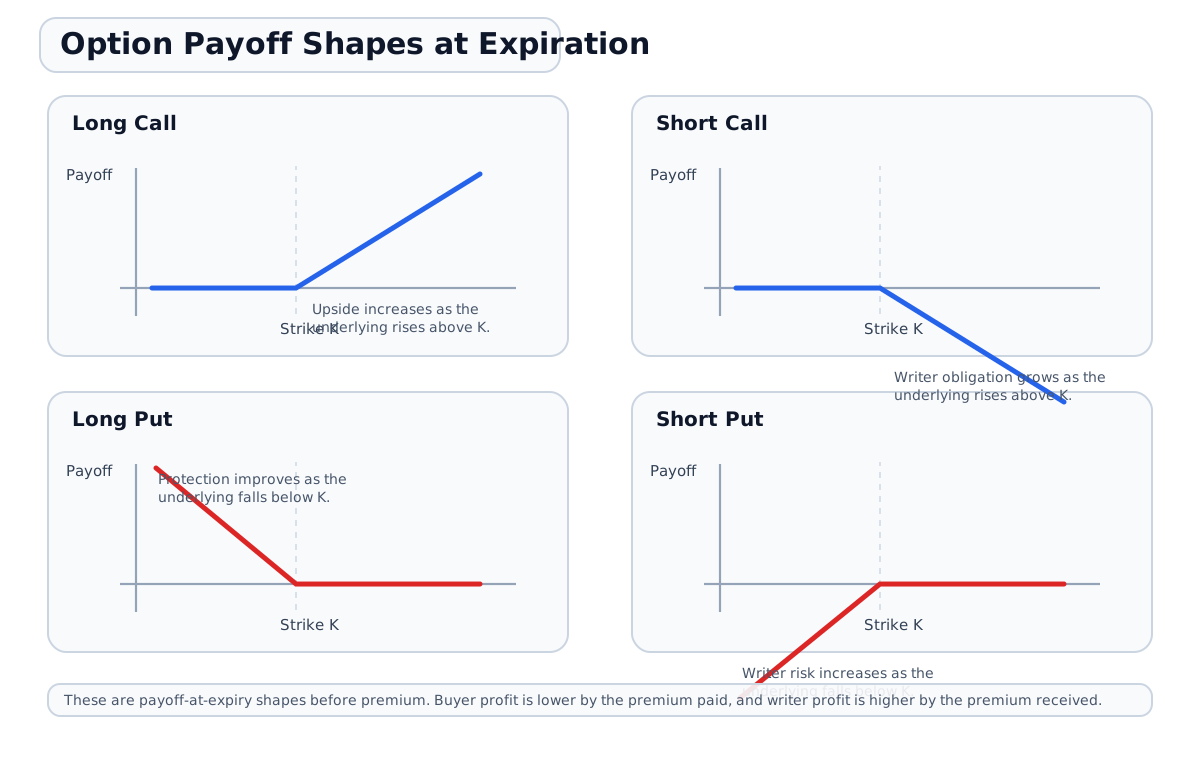
At expiry, a long call’s payoff before premium is:
At expiry, a long put’s payoff before premium is:
The writer’s payoff is the opposite side of the same contract.
Students should keep one distinction clear:
- payoff is the contract result at expiry
- profit equals payoff minus premium for the buyer, or premium received minus payoff for the writer
An option page benefits more from payoff geometry than from a flowchart because the main exam mistakes come from reversing who benefits when the underlying moves.
Basic Strategies Students Should Recognize
At the exam level, students should know several simple uses:
- long call for bullish speculation
- long put for bearish speculation or downside protection
- covered call for premium income on stock already owned
- protective put for downside protection on a long stock position
The exam may not require full strategy construction, but students should understand the purpose of these names.
Key Risk Characteristics
Option buyers generally face:
- limited loss
- time decay if the expected move does not happen
- leveraged upside from favourable moves
Option writers generally face:
- premium income up front
- exercise risk
- potentially large downside depending on whether the position is covered
Key Terms
- Call: Option giving the right to buy.
- Put: Option giving the right to sell.
- Premium: Price paid for the option.
- Intrinsic value: Immediate exercise value.
- Time value: Premium above intrinsic value.
Common Pitfalls
- Mixing up buyer rights with writer obligations.
- Confusing call direction with put direction.
- Treating intrinsic value and premium as the same thing.
- Forgetting that option buyers can lose 100% of premium paid.
- Ignoring whether the option writer is covered or uncovered.
Key Takeaways
- Calls and puts create different directional rights.
- Buyers have rights and limited loss; writers receive premium and take on obligations.
- Premium can be understood as intrinsic value plus time value.
- Moneyness depends on the relationship between underlying price and strike price.
- Basic option strategies are often framed around hedging or speculation.
Quiz
Sample Exam Question
A stock is trading at $52. A call option on the stock has a strike price of $50. Which statement is most accurate?
- A. The call is out of the money because the strike is below the stock price.
- B. The call has no intrinsic value because premium has already been paid.
- C. The call is at the money because the stock price is above the strike price.
- D. The call is in the money because the stock price is above the strike price.
Correct answer: D.
Explanation: A call option is in the money when the underlying price exceeds the strike price. Here, the stock is at $52 and the strike is $50, so the call has intrinsic value of $2 before considering premium. The other choices misclassify or misunderstand the position.