Duration, Convexity, and Price Sensitivity
Understand Macaulay duration, modified duration, effective duration, and convexity, and use them to estimate how bond prices respond to yield changes.
Duration and convexity are the main tools used to measure how sensitive a bond’s price is to changes in yield. They allow analysts to move from a general statement such as “longer bonds are more volatile” to a more precise estimate of how much a price may change when interest rates move.
For CSI IMT purposes, students should understand what each measure captures, when each is most useful, and why duration alone becomes less accurate when yield changes are large or when embedded options alter expected cash flows.
Why Duration Matters
Maturity tells an investor when the final principal payment is due. Duration is different. It measures the timing of all cash flows and therefore gives a better indication of price sensitivity than maturity alone.
In practice:
- higher duration usually means greater price sensitivity
- lower duration usually means smaller price changes for a given shift in yield
This is why two bonds with the same maturity can still have different duration values if their coupon structures differ.
Macaulay Duration
Macaulay duration is the weighted average time at which a bond’s cash flows are received.
Where:
- \( D_M \) is Macaulay duration
- \( CF_t \) is the cash flow in period \( t \)
- \( y \) is the yield per period
- \( P \) is the bond price
This measure is conceptually useful because it describes the weighted timing of value recovery.
Modified Duration
Modified duration converts the timing concept into a practical estimate of price sensitivity.
Modified duration is commonly used to estimate the percentage change in price for a small change in yield:
If modified duration is \( 6 \) and yields rise by \( 0.50% \), the approximate price decline is:
- \( 6 \times 0.005 = 0.03 \), or about \( 3% \)
This estimate is useful, but it is still an approximation.
Effective Duration
Effective duration is used when embedded options may change the expected timing of cash flows. This includes callable bonds and other securities whose cash-flow pattern can change when yields change.
Where:
- \( P_{-} \) is the price if yield falls
- \( P_{+} \) is the price if yield rises
- \( P_0 \) is the starting price
- \( \Delta y \) is the assumed yield change
Effective duration is especially important when plain modified duration would understate or misstate interest-rate risk because the bond’s expected cash flows may shift.
Convexity
Duration assumes the price-yield relationship is linear over a small range. In reality, it is curved. Convexity measures that curvature and improves the estimate when yields move more materially.
Most conventional non-callable bonds have positive convexity. That means:
- price rises accelerate when yields fall
- price declines are moderated slightly when yields rise
Callable bonds may display negative convexity over some ranges. In those cases, price appreciation is limited when yields fall because the issuer may redeem the bond early.
This topic is easier to retain visually because the formulas are describing timing, slope, and curve shape rather than three unrelated facts.
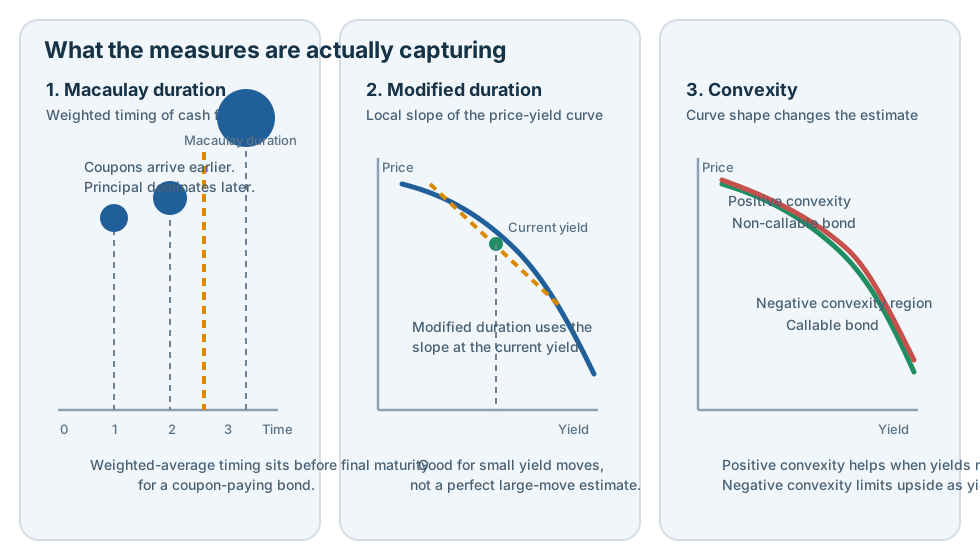
Read the figure from left to right. Macaulay duration explains weighted timing, modified duration explains the local price-yield slope, and convexity explains why callable and non-callable bonds can behave differently when yields move more materially.
Example
Suppose two bonds have the same yield and similar maturity, but one is a plain-vanilla government bond and the other is callable. Their modified durations may appear similar at first glance, but the callable bond’s effective duration will often be lower in a falling-rate scenario because the call feature limits upside.
This is why students should not treat duration measures as interchangeable. The correct measure depends on the bond’s structure.
Real-World Case Study
Periods of falling yields often expose the difference between positive and negative convexity. A conventional non-callable bond may appreciate strongly as rates fall. A callable bond may not, because the issuer can refinance and call the issue. The investor still benefits, but the upside is capped relative to a non-callable alternative.
That case matters for exam preparation because it shows why option features change risk measurement rather than merely adding a footnote to the description of the security.
Exam Focus
Strong answers in this section usually:
- explain that duration is a measure of price sensitivity, not just time to maturity
- use modified duration for a small-yield-change estimate
- identify effective duration as the better measure for option-embedded bonds
- explain convexity as the curvature that refines duration estimates
Common Pitfalls
- confusing maturity with duration
- forgetting that modified duration gives only an approximation
- using modified duration for callable bonds without acknowledging cash-flow change
- describing convexity without linking it to price behaviour