Technical Analysis and Its Limits
Understand the main tools of technical analysis, how they differ from fundamental analysis, and why chart signals should not override client fit in WME questions.
Technical analysis evaluates securities by studying price, volume, and market behaviour rather than business value alone. In WME questions, students are usually not being tested as active traders. They are more often being asked to identify what technical analysis is, what it can contribute, and why it should not override a client’s broader planning needs.
What Technical Analysis Examines
Technical analysis looks at market-generated information such as:
- price trends
- trading volume
- support and resistance levels
- moving averages
- momentum signals
The core assumption is that price behaviour can reveal patterns in market psychology and supply-demand balance.
Technical Versus Fundamental Analysis
| Question | Technical analysis | Fundamental analysis |
|---|---|---|
| Main focus | Price, volume, and market behaviour | Business quality, cash flow, balance sheet, and valuation |
| Typical use | Timing, momentum, and pattern recognition | Longer-term value and issuer assessment |
| Main WME trap | Letting a chart signal dominate suitability | Ignoring price and market context completely |
Common Technical Concepts
Several ideas appear repeatedly:
Trend
A trend describes the general direction of price movement. An upward trend suggests rising prices over time, while a downward trend suggests falling prices.
Support
Support is a price area where buying interest has previously been strong enough to slow or halt a decline.
Resistance
Resistance is a price area where selling interest has previously been strong enough to slow or halt an advance.
Moving averages
Moving averages smooth short-term fluctuations and are often used to identify whether price action is broadly strengthening or weakening.
Technical analysis is easier to retain when these ideas are seen on the same chart rather than memorized as separate definitions.
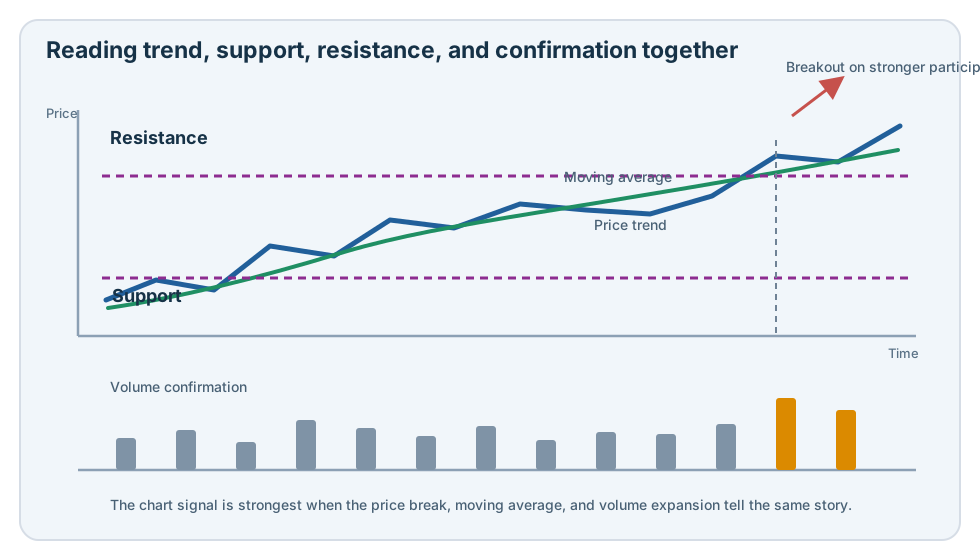
Use the chart as a recognition tool. The strongest interpretation usually combines more than one signal: trend direction, the location of support or resistance, and whether volume confirms the move.
How Technical Analysis Differs from Fundamental Analysis
Fundamental analysis asks what the business is worth. Technical analysis asks how the market is behaving.
That leads to different uses:
- fundamental analysis helps assess long-term value and business quality
- technical analysis may help with timing, sentiment, or trend recognition
The two methods are not the same, and students should not confuse them in case questions.
When Technical Analysis Can Be Useful
Technical analysis may be useful when:
- the client already has a suitable long-term strategy
- the question asks about timing or market behaviour
- price trend or momentum clearly affects a shorter-term trading decision
It is less useful as the main basis for a recommendation when the bigger issue is client suitability, risk capacity, or long-term planning alignment.
When Technical Signals Should Not Dominate
A common WME trap is recommending or defending an unsuitable security because the chart “looks good.” A short-term breakout does not repair:
- a mismatch with the client’s time horizon
- a concentration problem
- an inappropriate risk level
- weak business quality
- an urgent liquidity need
Technical analysis may refine a decision. It should not replace a sound wealth-management recommendation.
Example
A client needs capital stability because the funds may be used within a year. An advisor recommends a volatile equity because the stock has just broken above resistance on strong volume. Even if the technical signal is real, the recommendation may still be weak because the client’s short horizon is the more important fact.
Sample Exam Question
A stock has broken above resistance on strong volume, but the client may need the invested funds within a year and has low tolerance for volatility. What is the strongest WME conclusion?
- A. The breakout alone makes the recommendation suitable.
- B. The technical signal may be real, but the recommendation can still be weak because client fit is the more important issue.
- C. Technical analysis always overrides fundamental or suitability concerns.
- D. Resistance levels guarantee that the stock will not fall back.
Correct answer: B
Explanation: Technical analysis may contribute to timing, but it does not repair a mismatch with the client’s time horizon, liquidity needs, or risk tolerance.
Common Pitfalls
- treating technical analysis as proof of intrinsic value
- confusing a price breakout with a suitable recommendation
- ignoring time horizon and liquidity needs
- assuming chart patterns always work
- using technical language to disguise a weak client-fit analysis
Key Takeaways
- Technical analysis studies price and volume rather than business fundamentals.
- Trends, support, resistance, and moving averages are core concepts.
- Technical analysis and fundamental analysis answer different questions.
- Technical signals may help with timing, but they do not override suitability.
- In WME cases, broader planning fit usually matters more than a short-term chart pattern.