Yield Curves and Maturity Choice in Fixed Income
Understand normal, flat, and inverted yield curves and how maturity choice should still be anchored to client horizon, liquidity needs, and rate sensitivity.
The yield curve is a high-level summary of how yields differ across maturities for similar-credit-quality debt securities. In WME questions, students are usually being asked for a practical interpretation rather than an advanced term-structure theory. The important issue is what the curve may imply for maturity choice and risk exposure.
What the Yield Curve Shows
A yield curve plots:
- maturity on one axis
- yield on the other
To make the curve meaningful, the securities compared should have similar credit quality. Government of Canada debt is often used because it provides a cleaner comparison across maturities.
Common Yield-Curve Shapes
Three broad shapes appear most often in exam questions.
Normal curve
A normal yield curve slopes upward. Longer maturities offer higher yields than shorter maturities.
This often suggests:
- investors require more compensation for longer-term uncertainty
- market conditions are broadly consistent with a normal term premium
Flat curve
A flat yield curve shows similar yields across maturities.
This often suggests:
- the market sees less distinction between short and long rates
- uncertainty about the economic or policy path may be elevated
Inverted curve
An inverted yield curve slopes downward, with shorter maturities yielding more than longer maturities.
At a high level, this is often interpreted as a sign that markets expect weaker future growth or lower future short-term rates.
| Curve shape | What it usually suggests | Common weak interpretation |
|---|---|---|
| Normal | Longer maturities offer more yield for more uncertainty | Automatically extending maturity for every client |
| Flat | The yield difference across maturities is limited | Assuming maturity no longer matters |
| Inverted | The market expects weaker future conditions or lower future short rates | Treating long bonds as automatically superior |
Visual Reference
This is a case where SVG is more useful than Mermaid because the exact slope and shape are part of what the student must read correctly.
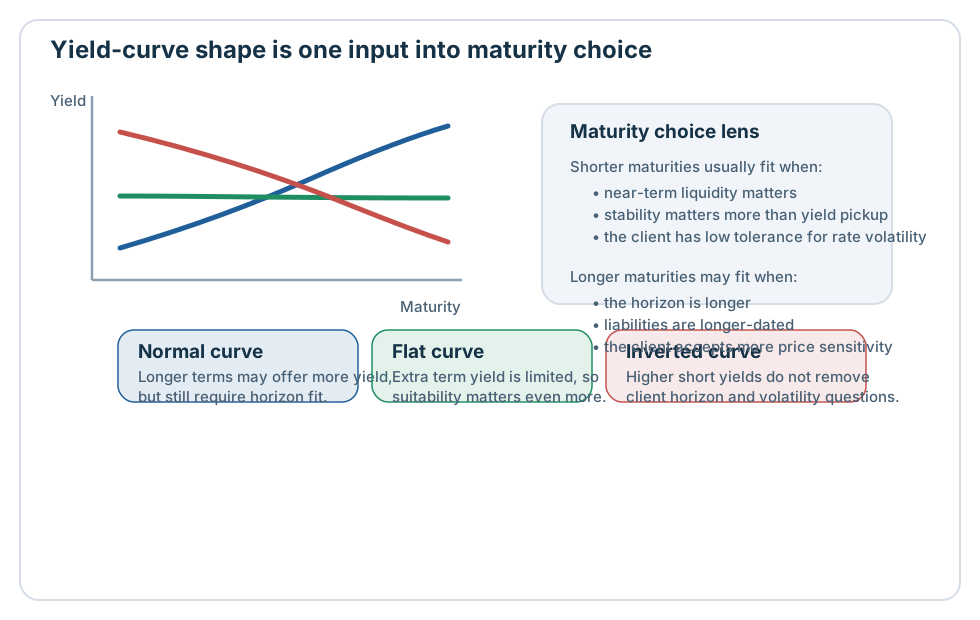
Use the left side to recognize the curve. Use the right side to keep the exam logic straight: curve shape may affect the maturity discussion, but it does not override the client’s liquidity needs, horizon, or tolerance for price volatility.
What the Curve Does and Does Not Tell You
The yield curve can provide useful clues, but it does not dictate a single portfolio answer. It does not mean:
- long bonds are always better in an inverted curve
- short bonds are always better in a normal curve
- the curve alone should override client needs
The curve is one input. The client’s objective, risk tolerance, and time horizon still matter.
Maturity Choice in Portfolio Context
When deciding between shorter and longer debt exposure, students should ask:
- Does the client need capital in the near term?
- Is the fixed-income allocation meant mainly for stability?
- Can the client tolerate price volatility from rate changes?
- Is the investor trying to match a longer-dated liability or spending horizon?
Shorter maturities usually fit better when stability and near-term liquidity matter most. Longer maturities may be more reasonable when the horizon is longer and the investor accepts more rate sensitivity.
Example
A client is conservative and expects to use part of the fixed-income allocation within two years. Even if the yield curve is upward sloping, extending aggressively into long maturities may still be a weak recommendation because the client has near-term capital needs. The curve may offer a little more yield at longer terms, but the client’s time horizon is the decisive factor.
Sample Exam Question
A conservative client expects to use part of the fixed-income allocation within two years. The yield curve is normal, so the advisor proposes extending far out the curve to pick up more yield. What is the strongest evaluation?
- A. The recommendation is automatically correct because a normal curve always justifies the longest maturity.
- B. The client may still be better served by shorter maturities because the horizon and need for stability matter more than the extra yield.
- C. Yield-curve shape eliminates interest-rate risk.
- D. A normal curve means all maturities are equally suitable.
Correct answer: B
Explanation: The yield curve is only one input. A client with near-term capital needs may still require shorter maturities even when longer debt offers somewhat higher yield.
Common Pitfalls
- treating the yield curve as a stand-alone recommendation tool
- assuming an inverted curve means all long bonds are automatically superior
- ignoring client horizon when discussing maturity
- confusing yield advantage with suitability
- treating yield-curve interpretation as a substitute for credit analysis
Key Takeaways
- The yield curve compares yields across maturities for similar-credit-quality debt.
- Normal, flat, and inverted curves each suggest different high-level market conditions.
- The curve helps interpret the maturity tradeoff, but it does not decide the recommendation by itself.
- Shorter maturities usually fit near-term stability needs better.
- In WME questions, the best maturity choice still depends on client objective and constraints.