Technical Analysis Tools and Signals
Read charts, trend, support and resistance, moving averages, momentum, sentiment, and cycle tools used in technical analysis.
Technical analysis studies price and volume behaviour in order to identify trend, momentum, support, resistance, and potential turning points. In the CSC, the goal is not to turn students into short-term traders. The goal is to help them recognize the logic of chart-based analysis and understand where its strengths and limits lie.
Technical analysis is most useful when the question is about timing, market sentiment, or price behaviour rather than business value.
Core Assumptions of Technical Analysis
Technical analysis rests on a few broad ideas:
- market behaviour is reflected in price and volume
- prices often move in trends
- recurring behaviour can create recognizable patterns
Students do not need to accept these ideas as perfect truths. They need to understand how technical analysts use them in practice.
Charts and Price Structure
The first task in technical analysis is to organize price information visually.
Common chart formats include:
- line charts
- bar charts
- candlestick charts
- point-and-figure charts
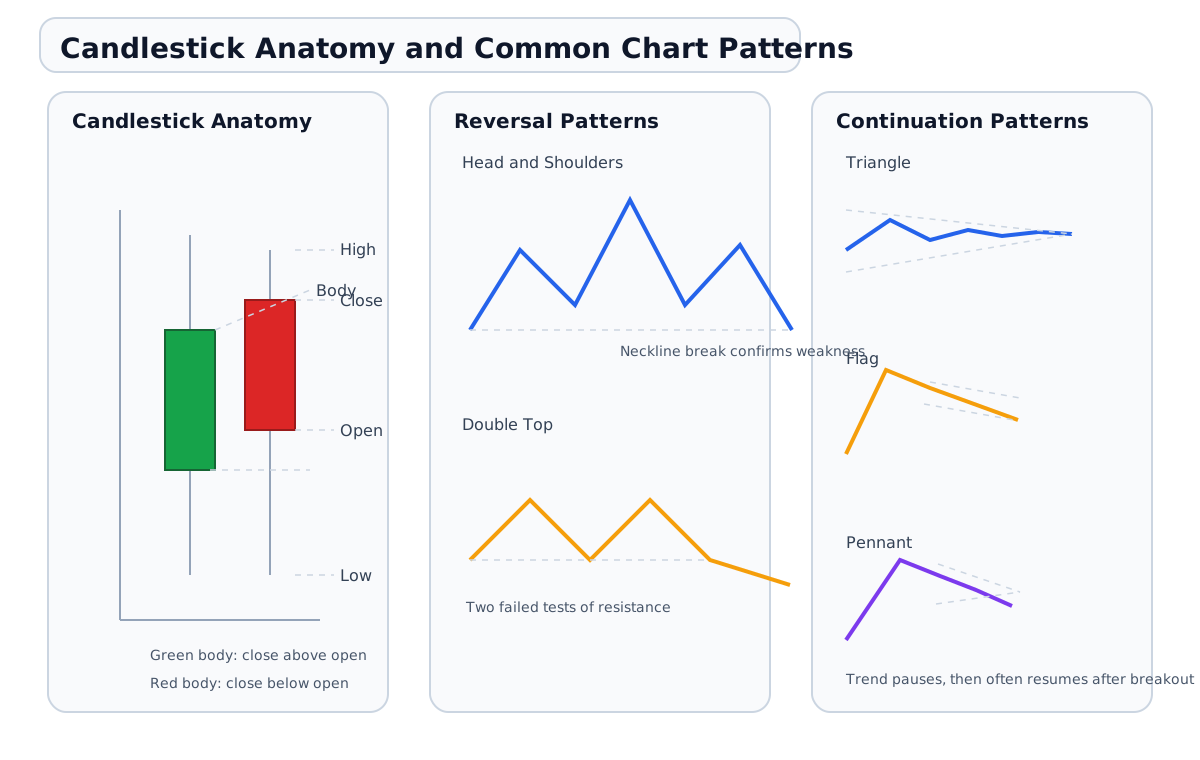
This visual reference matters because technical-analysis questions often depend on the exact pattern shape rather than on a verbal label alone.
For exam purposes, the precise drawing method matters less than the information being extracted: direction, volatility, and turning behaviour.
Trend, Support, and Resistance
Trend is one of the most important concepts in technical analysis.
- an uptrend shows rising highs and rising lows
- a downtrend shows falling highs and falling lows
- a sideways trend shows limited directional movement
Support is a price area where buying interest has tended to appear. Resistance is a price area where selling pressure has tended to emerge.
These levels matter because:
- a break above resistance may signal improving momentum
- a break below support may signal weakening demand
- repeated tests of the same level help traders judge market conviction
    flowchart TD
	    A[Price movement] --> B[Trend identification]
	    B --> C[Support level]
	    B --> D[Resistance level]
	    B --> E[Indicators and volume confirmation]
	    E --> F[Sentiment or cycle confirmation]
Chart Patterns
Technical analysts also look for patterns that suggest continuation or reversal.
Examples include:
- triangles and flags as continuation-style formations
- double tops and double bottoms
- head-and-shoulders formations as reversal patterns
The exam usually treats these patterns conceptually. Students should know that a pattern is being used to infer possible future direction, not to guarantee it.
Moving Averages and Quantitative Signals
Moving averages smooth price data and help identify trend direction.
At a high level:
- a shorter moving average reacts more quickly to recent price changes
- a longer moving average changes more slowly and may represent broader trend
Crossovers are often interpreted as signals. Students may also encounter the golden cross and death cross labels, but the main exam point is simpler: moving averages smooth price and can help identify trend changes. They still lag price rather than predict it perfectly.
Momentum Indicators
Two widely referenced indicators are RSI and MACD.
RSI
The relative strength index helps gauge momentum and whether a security appears overextended. It is often used to identify overbought or oversold conditions in a broad sense.
MACD
The moving average convergence divergence indicator tracks the relationship between moving averages and is used to judge momentum shifts.
The exam normally tests these indicators at a recognition level. Students should know what they are trying to show rather than memorize every calculation detail.
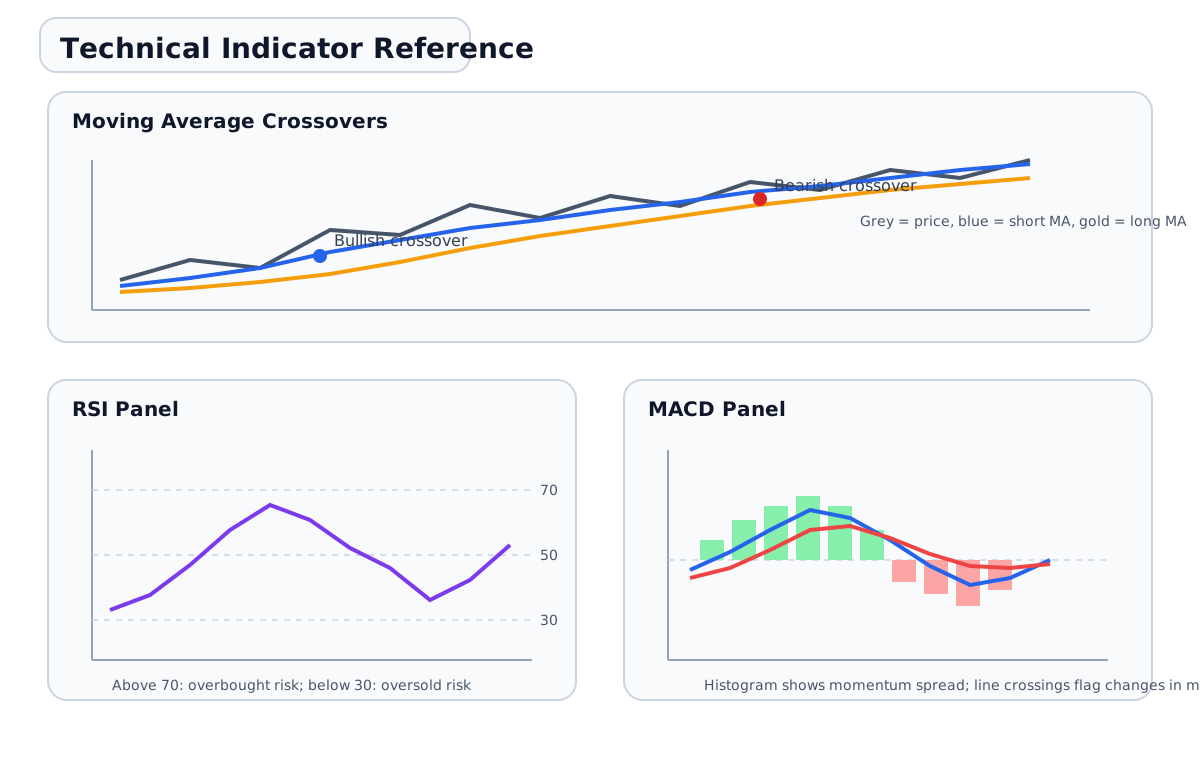
Use the figure to separate three jobs. Moving averages smooth trend, RSI highlights stretched momentum conditions, and MACD helps judge whether momentum is accelerating or fading.
Volume
Volume is important because it can strengthen or weaken the meaning of a price move.
For example:
- a breakout with strong volume may appear more convincing
- a price move with weak volume may deserve more caution
Technical analysis is often strongest when price, trend, and volume tell a coherent story.
Sentiment Indicators and Contrarian Use
Technical analysis also includes tools that try to measure market psychology.
Examples include:
- put/call ratios
- survey-based bullish or bearish sentiment measures
- volatility gauges such as the VIX
These indicators are often used in a contrarian way. Extreme optimism may suggest that buyers are already heavily committed. Extreme pessimism may suggest that a bearish move is already well advanced. The point is not that sentiment always reverses immediately, but that extremes can be informative.
Cycle Analysis
Some technical analysts also study recurring time patterns or cycles. These may be described as seasonal, intermediate, or longer-term cycles.
The practical use of cycle analysis is limited by one major problem: markets are often influenced by multiple overlapping cycles and by unexpected events that disrupt pattern recognition. Students should therefore treat cycle analysis as a supporting tool rather than as a source of certainty.
Limitations of Technical Analysis
Technical analysis has real limits, and the CSC expects students to recognize them.
Common limitations include:
- false breakouts and whipsaws
- subjective pattern interpretation
- indicators that lag price
- sentiment extremes that can persist longer than expected
- reduced usefulness when market conditions are unstable or highly event-driven
This is why technical analysis is often used as a probability framework rather than a source of certainty.
Technical Analysis and Risk Management
One reason technical analysis remains useful is that it can support disciplined risk management.
It can help investors:
- define entry and exit levels
- identify where the initial thesis may be invalidated
- avoid chasing prices without structure
Even investors who rely mostly on fundamentals may still use technical analysis for trade timing or risk control.
Key Terms
- Trend: General direction of price movement.
- Support: Price area where buying interest tends to appear.
- Resistance: Price area where selling pressure tends to appear.
- Moving average: Smoothed average of price data over time.
- Sentiment indicator: Tool used to gauge the market’s emotional or positioning bias.
Common Pitfalls
- Treating every chart pattern as a reliable forecast.
- Forgetting that indicators can lag.
- Ignoring volume when interpreting breakouts.
- Using sentiment indicators in isolation.
- Assuming technical analysis replaces the need for valuation or business analysis.
Key Takeaways
- Technical analysis studies price and volume behaviour rather than business value.
- Trend, support, resistance, and volume are central concepts.
- Moving averages, RSI, MACD, sentiment tools, and cycle analysis are common technical tools.
- Technical signals are probabilistic, not certain.
- Technical analysis is often most useful for timing and risk management.
Quiz
Sample Exam Question
A trader is reviewing a stock that has been in an uptrend. The price approaches a long-observed resistance level and then breaks above it on unusually strong volume. At the same time, sentiment measures show that optimism is becoming extreme.
Which interpretation is strongest?
- A. The breakout should be ignored because technical analysis never uses volume or sentiment.
- B. The move guarantees a profitable trade because a breakout above resistance always succeeds.
- C. The breakout may be technically meaningful because price cleared resistance on strong volume, but the trader should still be cautious because sentiment extremes can increase reversal risk.
- D. The move is irrelevant because support and resistance matter only in bond markets.
Correct answer: C.
Explanation: The resistance break and strong volume support the idea that the move may be technically meaningful. However, no technical signal is guaranteed, and extreme sentiment can warn that the move may already be crowded. Choice C captures both the signal and the limitation. Choices A, B, and D are incorrect or too absolute.