Basics of Technical Analysis
Learn the basic assumptions, strengths, limits, and practical logic of technical analysis in the CSI IMT exam context.
Technical analysis is the study of market-generated data, especially price and volume, to identify trends, momentum, support and resistance, and possible turning points. The technical analyst starts from the market itself rather than from financial statements or intrinsic-value models. The method assumes that market behaviour contains useful information and that recurring patterns in that behaviour can help with investment decisions.
For CSI IMT purposes, technical analysis should be understood as a decision-support tool rather than a forecasting machine. It helps investors interpret market action, but it does not eliminate uncertainty.
Core Assumptions of Technical Analysis
Technical analysis is built on three broad assumptions.
Market Action Discounts Known Information
Technical analysts assume that publicly known information, and much of the market’s interpretation of that information, is already reflected in price. This does not mean prices are always correct. It means that price behaviour is treated as a useful summary of changing expectations.
Prices Move in Trends
Another core assumption is that prices often move in discernible trends rather than in a purely random sequence. Technical analysis therefore places great importance on identifying whether the prevailing direction is upward, downward, or sideways.
Behaviour Repeats
Technical analysis is also influenced by the idea that investor behaviour shows recurring patterns. Fear, greed, overreaction, hesitation, and herd behaviour can produce chart patterns and momentum behaviour that resemble prior market episodes.
Price, Volume, and Market Psychology
Price shows where buyers and sellers have agreed to trade. Volume helps indicate how much conviction stands behind that price movement. A price rise on heavy volume may be more convincing than a similar rise on light volume because more participants supported the move.
Technical analysis therefore often combines:
- price direction
- trading volume
- trend strength
- momentum behaviour
This combination helps analysts distinguish between a durable move and a weak move that may fade quickly.
Trends, Support, and Resistance
Three foundational ideas appear repeatedly in technical analysis.
Trend
A trend is the general direction of price movement over time. An uptrend usually involves higher highs and higher lows. A downtrend usually involves lower highs and lower lows.
Support
Support is a price zone where buying interest has historically been strong enough to slow or stop a decline.
Resistance
Resistance is a price zone where selling pressure has historically been strong enough to slow or stop an advance.
These levels are not guarantees. They are areas of repeated market behaviour that may or may not hold in the future.
This is one of the topics where an SVG is more useful than prose alone because the learner needs to see the levels, the trend, and the confirmation signal on the same chart.
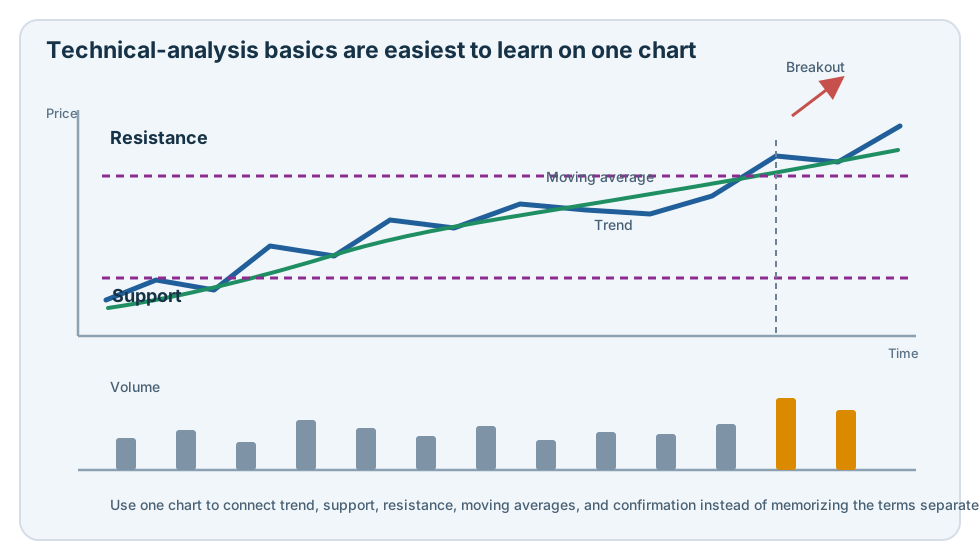
Read the figure from top to bottom. The upper panel shows the trend, moving average, support, and resistance. The lower panel shows why technicians care about volume: the breakout matters more when participation expands with it.
Time Horizon Matters
Technical analysis can be applied over many time frames, including intraday, daily, weekly, and monthly charts. The meaning of a signal depends partly on the time frame used. A move that appears important on a daily chart may be routine noise on an intraday chart, while a weekly breakout may matter more for a long-term investor than a short-lived daily swing.
For exam purposes, students should match the technical interpretation to the likely investor horizon implied by the question.
Strengths of Technical Analysis
Technical analysis can be useful because it:
- helps identify market trends and turning points
- offers a framework for timing entry and exit decisions
- supports risk management through support, resistance, and stop levels
- reflects market behaviour directly rather than relying only on issuer data
It is especially useful when the analyst needs a structured way to interpret momentum and market sentiment.
Limits of Technical Analysis
Technical analysis also has important limits:
- patterns can be subjective
- false breakouts and whipsaws are common
- signals may fail in unusual market conditions
- technical tools do not replace business analysis
The strongest exam answer usually recognizes both the usefulness and the limitations of the method.
Example
Suppose a stock rises above a well-established resistance level on unusually heavy volume. A technical analyst may interpret that as a potentially meaningful breakout. However, the stronger conclusion is not that the stock must continue rising. The stronger conclusion is that the move has evidence of strength and deserves closer attention and confirmation.
Common Pitfalls
- treating technical analysis as certain prediction
- assuming support or resistance is permanent
- using a short-term chart to make a long-term conclusion without adjustment
- ignoring the role of volume and confirmation
Exam Focus
CSI IMT questions on technical-analysis basics often test whether students understand the method’s assumptions, how price and volume are interpreted, and why technical signals should be treated as evidence rather than certainty.