Statistical Analysis
Interpret moving averages, momentum indicators, oscillators, and volatility-based tools in the CSI IMT context.
Statistical analysis in technical work uses mathematical summaries of market behaviour to help identify trend direction, momentum, volatility, overbought or oversold conditions, and possible turning points. These tools do not replace price analysis. Instead, they help structure interpretation of the data already contained in price and volume.
For CSI IMT purposes, students should understand what the most common indicators are designed to measure, what they can help reveal, and where they may generate misleading signals.
Why Statistical Indicators Are Used
Raw price data can be noisy. Statistical indicators help simplify that information by smoothing data, measuring speed of change, or comparing price movement with recent history. This can make trend and momentum behaviour easier to interpret.
The main categories include:
- trend-following indicators
- momentum indicators
- oscillators
- volatility-based indicators
Moving Averages
Moving averages are among the most common trend-following tools. They smooth price data and help identify underlying direction.
Simple Moving Average
The simple moving average is the average of closing prices over a chosen period.
Where:
- \( P_1 \dots P_n \) are the prices in the chosen period
- \( n \) is the number of observations
Shorter moving averages react more quickly to price changes. Longer moving averages respond more slowly and are often used to judge broader trend direction.
Moving Average Crossovers
When a shorter moving average crosses above a longer moving average, analysts sometimes interpret that as a bullish signal. When it crosses below, the signal may be interpreted as bearish. However, crossovers can lag turning points and can produce false signals in sideways markets.
Momentum Indicators
Momentum indicators measure the speed of price movement. They are designed to show whether an advance or decline is strengthening or weakening.
Rate of Change
Rate of change compares a current price with a prior price.
Where:
- \( P_t \) is the current price
- \( P_{t-k} \) is the price \( k \) periods earlier
Momentum can remain positive while weakening, or negative while improving. This is why momentum interpretation often matters more than the number alone.
Oscillators
Oscillators are indicators that move within a band or around a central value. They are often used to identify overbought or oversold conditions or possible momentum divergence.
Examples include:
- relative strength index (RSI)
- stochastic oscillator
- moving average convergence divergence (MACD), which is often treated as both a momentum and trend tool
An overbought reading does not necessarily mean price must fall immediately. It usually means the recent advance has been strong relative to the indicator’s look-back period.
Divergence
Divergence occurs when price and an indicator move in different directions. For example:
- price makes a higher high, but the indicator does not
- price makes a lower low, but the indicator does not
Technical analysts often interpret this as a warning that trend strength may be weakening. Divergence is a caution signal, not a guarantee of reversal.
Volatility and Bands
Some indicators attempt to show whether price is relatively stretched or compressed. Bands built around moving averages are one example. These tools can help students interpret whether recent price movement has become unusually volatile, but they must still be read in trend context.
Indicator Reference
The figure below works better than a flowchart because each indicator answers a different visual question.
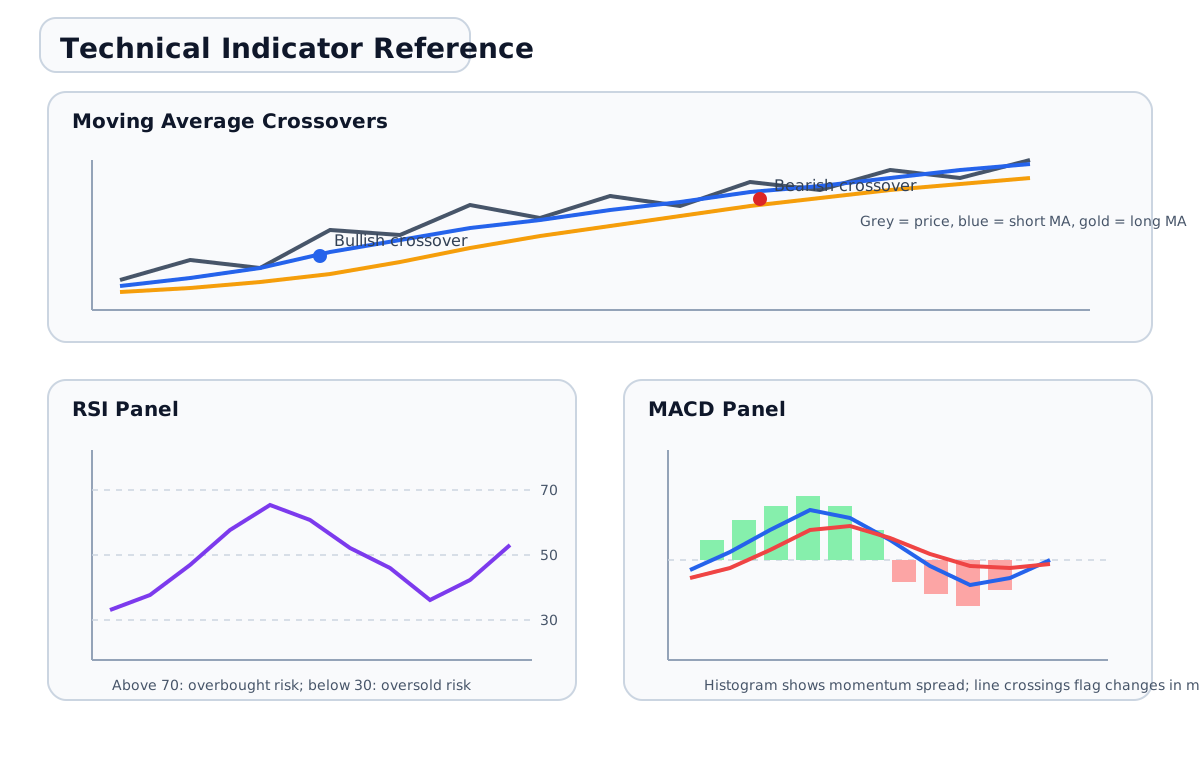
Moving averages help with trend direction and crossover timing. RSI helps frame whether momentum has become stretched relative to its recent range. MACD helps compare momentum and trend change through line crossings and histogram expansion or contraction.
Strengths and Limits
Statistical indicators are useful because they:
- impose structure on noisy data
- help identify trend and momentum changes
- support confirmation or caution
They are limited because:
- many are lagging rather than leading
- they can produce false signals in sideways markets
- they may encourage over-reliance on one number
The strongest exam answer usually treats indicators as aids to interpretation, not as automatic trading commands.
Example
Suppose a stock continues to rise, but its momentum indicator begins to flatten and then turn down. The stronger interpretation is not that the uptrend has definitely ended. It is that the trend may be losing strength and should be watched more carefully for confirmation.
Common Pitfalls
- treating moving-average crossovers as certain signals
- assuming overbought means immediate decline
- ignoring the underlying price trend when reading oscillators
- using one indicator without confirmation from price or volume
Exam Focus
CSI IMT questions in this area often test whether students know what an indicator measures and how to interpret it cautiously. The strongest answer typically explains both the signal and its limitation.