Chart Analysis
Interpret chart types, trendlines, support and resistance, candlestick behaviour, and common price patterns in the CSI IMT context.
Chart analysis is the visual side of technical analysis. It involves interpreting price movement through line charts, bar charts, candlestick charts, trendlines, support and resistance zones, and recurring chart patterns. The purpose is not to admire chart shapes. The purpose is to judge whether market behaviour suggests continuation, reversal, hesitation, or confirmation.
For CSI IMT purposes, students should know how to interpret basic chart information and common patterns without treating chart signals as automatic forecasts.
Main Chart Types
Line Charts
Line charts usually connect closing prices over time. They are simple and useful for identifying broad direction, but they do not show the full trading range within each period.
Bar Charts
Bar charts show the open, high, low, and close for each period. They provide more information than line charts and help analysts judge price range and closing behaviour.
Candlestick Charts
Candlestick charts also show open, high, low, and close, but they present the data in a more visual way. The candle body shows the distance between open and close, while the shadows show the high and low.
Candlesticks are widely used because they make market control easier to read. A large upward candle suggests strong buying for that period, while a large downward candle suggests strong selling.
Reading Trendlines
Trendlines are drawn to connect significant highs or lows. They help show the prevailing direction of price.
- in an uptrend, analysts often connect higher lows
- in a downtrend, analysts often connect lower highs
A trendline can help identify whether price is respecting the trend or weakening. A break of a trendline may be important, but it is usually stronger when confirmed by volume, follow-through, or a broader pattern.
Support and Resistance
Support and resistance are central to chart analysis.
- support is a zone where demand has previously been strong enough to slow declines
- resistance is a zone where supply has previously been strong enough to slow advances
When price breaks through resistance and then holds above it, that former resistance may begin acting as support. This is one of the most common chart-based interpretations in exam questions.
Candlestick Behaviour
Technical analysts use candlestick behaviour to judge market psychology over short periods. Examples include:
- long bullish candles, which may indicate strong buying pressure
- long bearish candles, which may indicate strong selling pressure
- small-bodied candles, which may indicate indecision
- reversal-style candles, such as hammers or engulfing patterns, which may suggest a shift in control
The strongest interpretation always considers context. A hammer in the middle of a quiet range does not carry the same significance as a hammer after a sharp decline at a major support zone.
Common Chart Patterns
Head and Shoulders
This pattern is often interpreted as a possible reversal from an uptrend to a downtrend. The pattern becomes more meaningful when the neckline is broken with confirmation.
Double Top and Double Bottom
These patterns suggest that a price area has been tested twice. A double top may indicate resistance and potential reversal, while a double bottom may indicate support and potential reversal.
Triangles
Triangles often reflect consolidation before a breakout. The direction of the eventual breakout matters more than the shape alone.
Flags and Pennants
These are usually interpreted as short consolidations within a stronger existing trend. They are often treated as continuation patterns rather than reversal patterns.
Visual Pattern Reference
The figure below is useful because the exact visual shape is part of the lesson.
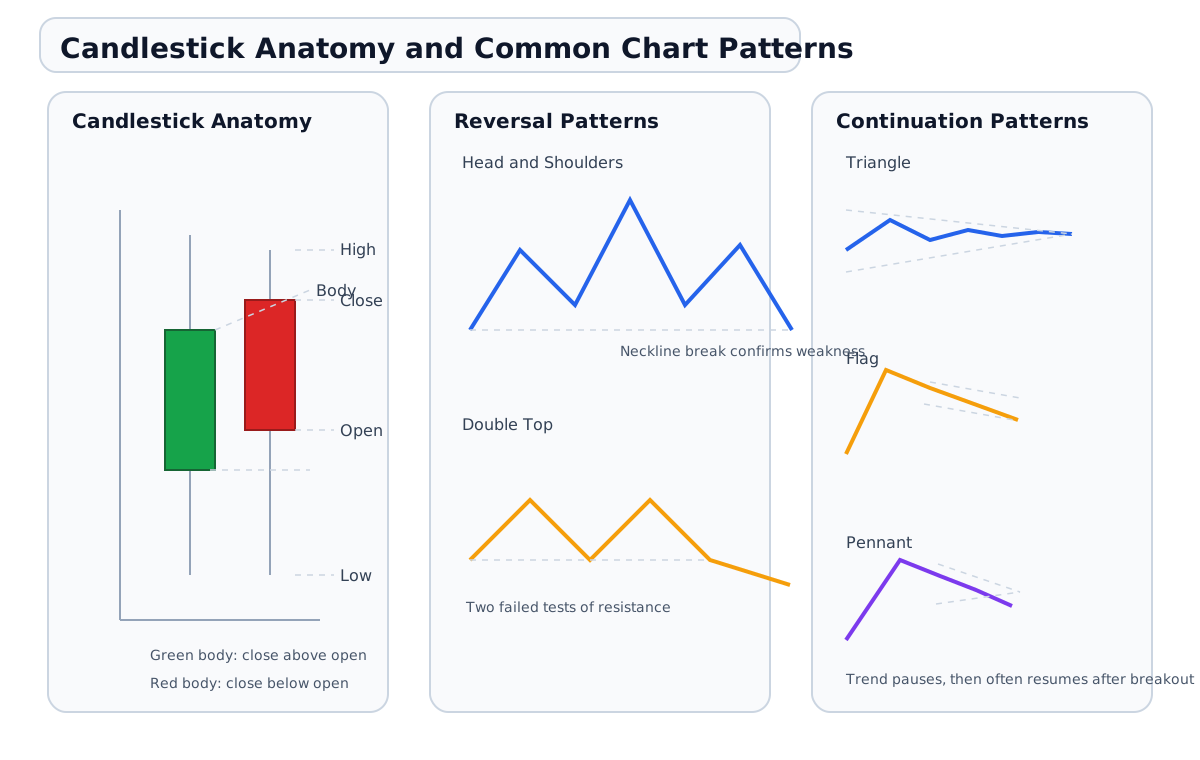
Read the figure from left to right. Start with candlestick anatomy, then move to reversal and continuation patterns. In exam questions, the strongest answer usually explains what the shape suggests and what confirmation would still be needed.
Volume Confirmation
Chart analysis is stronger when price action and volume support each other. For example:
- a breakout on rising volume is often treated as more credible
- a breakout on weak volume may be treated more cautiously
This does not mean volume guarantees success. It means volume often helps distinguish a stronger signal from a weaker one.
Decision Rule for Exam Questions
When a chart pattern appears in a question, the strongest process is usually:
- identify the prevailing trend
- identify the key support or resistance area
- interpret the pattern in context
- ask whether there is confirmation from price follow-through or volume
This is usually stronger than naming the pattern without explanation.
Example
Suppose a stock has been rising for several months, then forms a double top near a major resistance zone and falls below interim support on heavier volume. The stronger interpretation is not merely “double top.” It is that price has failed twice at resistance and the downside break may signal weakening momentum and a possible reversal.
Common Pitfalls
- naming a pattern without checking trend context
- assuming a pattern is valid before confirmation
- ignoring support, resistance, and volume
- treating every candlestick pattern as equally important
Exam Focus
CSI IMT chart-analysis questions usually test whether students can interpret chart information logically. The strongest answer often explains the pattern, the context, and the confirmation requirement together.