Bond Indexes and Benchmark Matching
How bond indexes are built, why benchmark choice matters, and how index composition affects passive investing and performance measurement.
Bond indexes turn a large and fragmented market into something that can be measured, compared, and tracked. They help investors describe the bond market, evaluate manager performance, and build passive products.
The exam point is not to memorize one index provider. It is to understand what an index includes, how it is weighted, and why the wrong benchmark can produce a misleading conclusion about performance.
What a Bond Index Does
Bond indexes are used to:
- measure broad market performance
- compare active managers with a benchmark
- support passive mutual funds and ETFs
- summarize sector, credit, and duration exposure
- help investors define an investable fixed-income universe
An index is therefore both a measurement tool and a portfolio-design tool.
Index Construction Is Rule-Based
A bond index does not contain every bond in existence. It includes only the bonds that satisfy the index rules.
Typical eligibility rules may involve:
- issuer category
- maturity range
- minimum issue size
- credit-quality threshold
- currency
- liquidity or tradability screens
That means index composition reflects design choices, not neutral market truth.
Weighting Methods Shape the Result
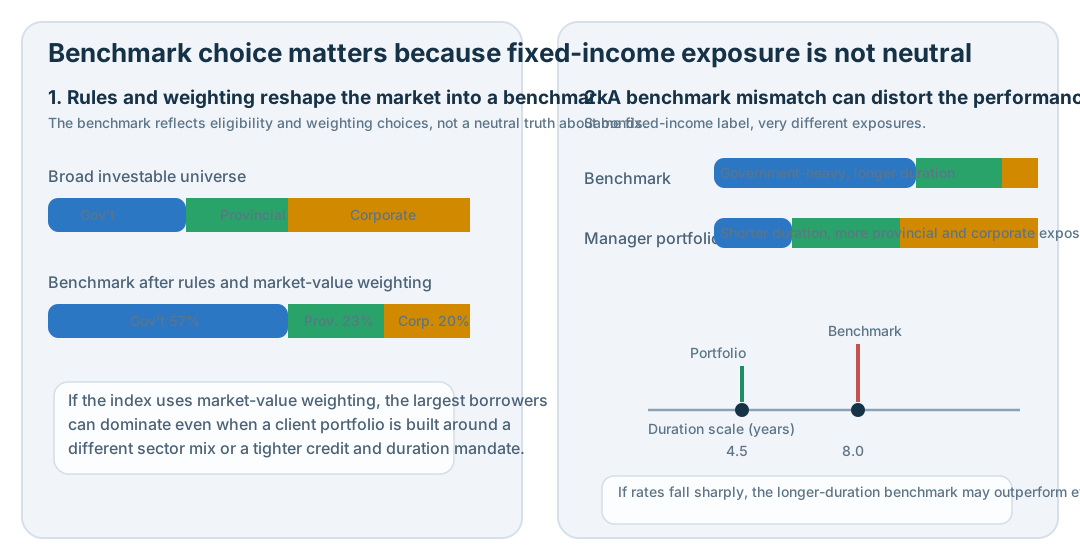
Many broad bond indexes are weighted by market value or debt outstanding. That has an important consequence:
- the largest borrowers often receive the largest weights
This is different from an intuitive idea of “best bonds first.” Market-value weighting tells the investor where the debt is, not necessarily where the best relative value is.
Other index approaches may use equal weighting, duration targeting, or more specialized rule sets, but the main exam idea is that weighting choice changes both risk exposure and performance behaviour.
    flowchart LR
	    A[Bond market universe] --> B[Index eligibility rules]
	    B --> C[Eligible bonds]
	    C --> D[Weighting method]
	    D --> E[Index composition]
	    E --> F[Benchmark and passive products]
Rebalancing Changes the Index Over Time
Bond indexes are dynamic. They change because:
- new issues come to market
- old issues mature
- duration profiles shift
- issuer weights change
- credit events can change eligibility
This means a benchmark is not static. A portfolio compared with the same broad index over time may still be compared against a changing mix of risk exposures.
Benchmark Matching Is Essential
A benchmark should resemble the portfolio’s real opportunity set. Students should ask:
- Does the benchmark have similar duration?
- Does it have similar credit quality?
- Does it reflect the same issuer mix?
- Does it represent the same maturity range and market segment?
If the answer is no, relative performance may tell more about benchmark mismatch than manager skill.
A short-duration corporate strategy should not be judged casually against a broad long-duration government-heavy universe.
Bond Indexes and Passive Investing
Passive bond funds and ETFs attempt to track an index rather than beat it through security selection. That introduces three practical ideas:
- replication or sampling of index constituents
- tracking difference between the fund and the benchmark
- turnover as the index rebalances
Passive investing in fixed income is not as simple as buying “the market” once and leaving it unchanged. The benchmark itself evolves.
Limits of Index Comparisons
Bond indexes are useful, but they have limits.
- a specialized mandate may not fit a broad benchmark
- market-value weighting can concentrate exposure in the biggest issuers
- illiquid segments may be hard to track perfectly
- credit and duration mismatch can distort conclusions about manager skill
Good benchmarking therefore requires both return comparison and risk comparison.
Key Terms
- Bond index: Rule-based measure of a basket of bonds.
- Benchmark: Reference used to compare performance and risk.
- Market-value weighting: Weighting based on market size or debt outstanding.
- Rebalancing: Periodic updating of the index composition.
- Tracking difference: Gap between fund performance and benchmark performance.
Common Pitfalls
- Assuming every broad index is a fair benchmark for every bond strategy.
- Forgetting that the largest borrowers may dominate a market-value-weighted index.
- Ignoring duration mismatch when interpreting performance.
- Treating benchmark choice as an afterthought.
- Assuming passive bond investing involves no turnover or implementation challenge.
Key Takeaways
- Bond indexes measure markets, support benchmarking, and enable passive investing.
- Index rules determine what is included and how it is weighted.
- Market-value weighting often gives the largest weights to the largest borrowers.
- Benchmarks should match duration, credit, and sector exposure.
- Performance comparison without benchmark fit can be misleading.
Quiz
Sample Exam Question
A manager runs a short-duration portfolio focused on investment-grade provincial and corporate bonds. The firm evaluates the strategy against a broad Canadian bond benchmark with much heavier Government of Canada exposure and materially longer duration.
Which statement is most accurate?
- A. The comparison is automatically fair because all bond indexes represent the same market.
- B. The comparison may be misleading because duration and sector mix differ materially between the portfolio and the benchmark.
- C. The benchmark is irrelevant because bond funds do not use index comparisons.
- D. The broad benchmark must hold more corporate bonds because market-value weighting favours higher-yield issuers.
Correct answer: B.
Explanation: A benchmark should reflect the portfolio’s actual opportunity set and risk profile. If duration and sector composition differ sharply, relative return can be driven by exposure mismatch rather than manager skill. The other choices misunderstand either benchmarking or weighting logic.