Bond Trading, Liquidity, and Settlement
How Canadian bonds trade over the counter, how dealer liquidity affects execution, and why settlement, accrued interest, and T+1 matter.
Bond market trading matters because a bond’s theoretical value is not always the same as its executable price. In Canada, most fixed-income trading still occurs through dealers in an over-the-counter market rather than through a centralized exchange.
Students should understand how that market structure affects liquidity, bid-ask spreads, settlement, and the practical difference between a quoted price and the cash amount that changes hands on settlement.
The Bond Market Is Primarily Dealer-Based
Most Canadian bond trading is conducted in an OTC dealer market.
- dealers quote bid and ask prices
- dealers may hold inventory
- institutional investors dominate much of the volume
- retail investors usually access the market through dealers or advisors
That structure is different from the continuous exchange-style trading students associate with large-cap equities.
Liquidity Is Uneven Across Issues
Liquidity is the ability to buy or sell without moving price materially. In bonds, liquidity varies sharply across issuers and issues.
More liquid bonds usually include:
- benchmark Government of Canada issues
- larger provincial issues
- actively traded high-quality corporate issues
Less liquid bonds may include:
- smaller corporate issues
- thinly traded debentures
- specialized or infrequently followed credits
The result is that two bonds with similar maturity may still trade with very different bid-ask spreads and execution quality.
Dealer Quotes, Spreads, and Execution
Because dealers stand between buyers and sellers, price discovery often appears through quoted spreads rather than through a visible central order book.
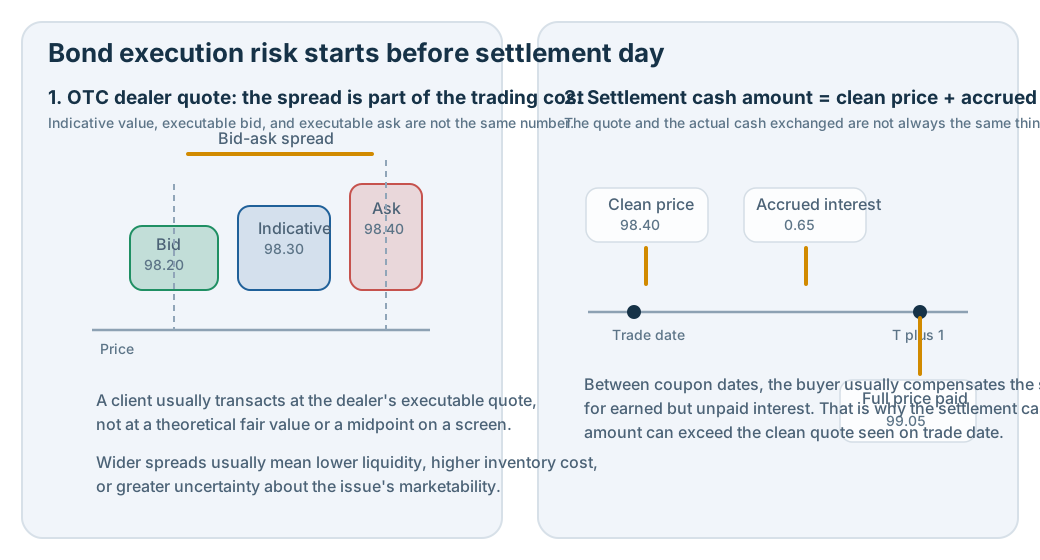
- the bid is the dealer’s buying price
- the ask is the dealer’s selling price
- the spread is the trading cost implied by the difference
Wider spreads often mean lower liquidity, more uncertainty, or more balance-sheet cost for the dealer.
Students should not confuse:
- a bond’s theoretical fair value
- a screen quote or indicative quote
- the actual executable bid or ask
- the final settlement amount
Settlement and Delivery
Agreeing on price does not complete the trade. Settlement still must occur through delivery of the securities and payment of cash.
In Canada, the normal trade settlement cycle for standard securities trades moved from T+2 to T+1 in May 2024. For fixed-income questions, the important point is that regular-way settlement now happens faster than under the old convention, although product-specific exceptions and special terms can still exist.
Students should connect settlement with operational risk:
- failed trades create processing and funding problems
- shorter settlement cycles reduce some market and counterparty exposure
- firms still need accurate trade details and timely allocations
Accrued Interest Still Matters at Settlement
For coupon bonds trading between interest-payment dates, the buyer normally compensates the seller for accrued interest.
That means the amount paid at settlement is often:
- clean quoted price
- plus accrued interest
- equals dirty or full price
This is a pricing point, but it is also a trading point because it affects the actual cash exchanged.
Liquidity Risk and Client Outcomes
Bond-market structure matters to clients because trading cost and execution quality are not identical across issues.
Less liquid bonds may involve:
- wider bid-ask spreads
- harder price verification
- more difficulty exiting a position quickly
- extra yield demanded by investors as compensation
At the exam level, the main lesson is that higher yield may partly reflect poorer liquidity rather than better value.
Electronic Trading Has Improved Access, but Not Uniformly
Electronic platforms have improved quoting and execution in parts of the Canadian bond market, especially in more standardized and liquid segments. Even so, the market has not become perfectly transparent or equally liquid across all issues.
Students should avoid assuming that every bond can be traded with the same speed and visibility as a large exchange-listed stock.
Key Terms
- OTC market: Dealer-based market outside a centralized exchange.
- Bid-ask spread: Gap between purchase and sale quotations.
- Liquidity: Ease of trading without major price impact.
- Settlement date: Date when cash and securities are exchanged.
- Accrued interest: Interest earned by the seller since the last coupon payment.
Common Pitfalls
- Assuming all bonds are highly liquid.
- Ignoring bid-ask spread when evaluating realized return.
- Forgetting that the settlement amount can exceed the clean quote.
- Using outdated T+2 language for standard Canadian settlement.
- Treating an indicative quote as the same thing as guaranteed executable price.
Key Takeaways
- Most Canadian bond trading is OTC and dealer-driven.
- Liquidity varies materially across issuers and issues.
- Bid-ask spreads are a real part of trading cost.
- Regular-way Canadian settlement now uses T+1 for standard securities trades.
- Clean price is not the same as the full cash amount paid on settlement.
Quiz
Sample Exam Question
A retail client compares two 8-year bonds with similar credit quality. One is a large, actively traded Government of Canada benchmark issue. The other is a smaller, infrequently traded corporate issue that offers a higher yield.
Which explanation is most accurate?
- A. The corporate bond may need to offer extra yield because lower liquidity and wider spreads can reduce execution quality and raise trading cost.
- B. The government bond cannot be sold before maturity.
- C. The corporate bond must have no accrued interest at settlement.
- D. The higher yield proves the corporate bond is mispriced rather than riskier or less liquid.
Correct answer: A.
Explanation: A less liquid bond may need to offer extra yield because investors face wider bid-ask spreads, less transparent pricing, and more difficult execution. The other choices misunderstand marketability, settlement, or the meaning of higher yield.