Duration and Bond Price Volatility
The core bond-pricing properties, including inverse price-yield moves, maturity and coupon effects, yield-level effects, duration, and convexity.
Once students understand that bond prices and yields move in opposite directions, the next question is magnitude. Which bond will move more when yields change? The answer comes from a small set of core pricing properties.
This topic is highly testable because it rewards comparison. Students are often given two or more bonds and asked which is more volatile. The correct answer usually comes from maturity, coupon rate, yield level, duration, or optionality.
The First Property: Price and Yield Move in Opposite Directions
This is the starting point for every later comparison.
- when yield rises, bond price falls
- when yield falls, bond price rises
That inverse relationship exists because the bond’s contractual cash flows are fixed while the market discount rate changes.
The Maturity Effect
All else equal, longer-maturity bonds are more sensitive to changes in yield than shorter-maturity bonds.
Why? More of the bond’s value depends on cash flows that arrive far in the future. Those distant cash flows are more affected by changes in the discount rate.
For exam purposes, this gives a reliable comparison rule:
- longer maturity usually means greater price volatility
- shorter maturity usually means lower price volatility
The Coupon Effect
All else equal, lower-coupon bonds are more sensitive to yield changes than higher-coupon bonds.
Higher-coupon bonds return more cash to the investor earlier. That shortens the weighted average time to receive value and reduces sensitivity to future discount-rate changes.
Lower-coupon bonds depend more heavily on the final repayment at maturity, so their prices usually move more for a given change in yield.
The Yield-Level Effect
Equal changes in yield do not always produce equal percentage price changes across all starting yield levels.
At lower starting yields, a given basis-point move often causes a larger percentage price change than the same move at a much higher starting yield. Students should not treat this as a separate bond type. It is another reminder that price sensitivity depends on the full pricing context, not on maturity alone.
Duration Summarizes Interest-Rate Sensitivity
Duration is a measure of how sensitive a bond’s price is to changes in yield. It combines the maturity effect and the coupon effect into one practical comparison tool.
Two duration ideas are especially useful:
- Macaulay duration is a weighted average time to receive cash flows
- modified duration converts that idea into an approximate price-sensitivity measure
The common approximation is:
This does not give a perfect answer, but it gives a strong directional estimate. Higher modified duration usually means greater price sensitivity.
This comparison is easier to learn from geometry than from a flowchart because the exam issue is how much price changes under the same rate move.
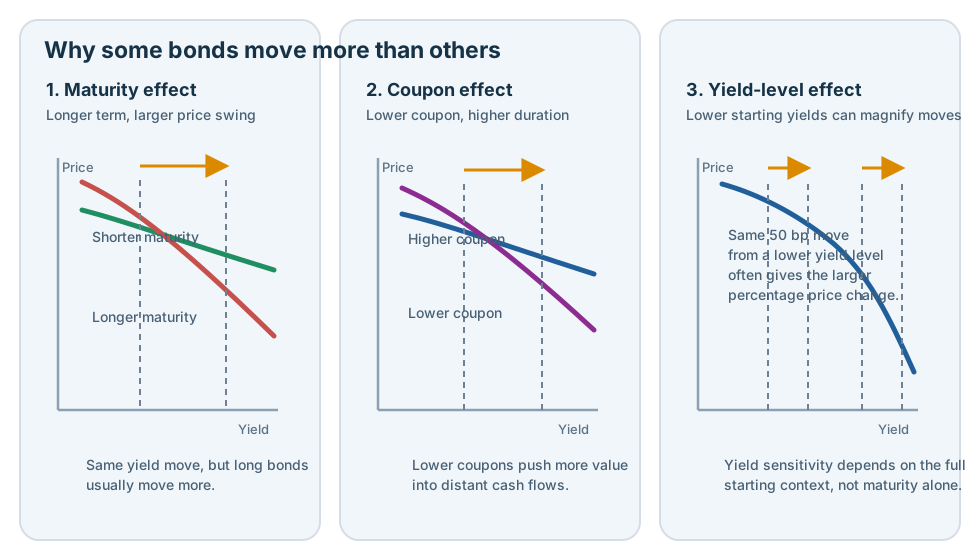
The figure shows the three recurring comparison rules. Longer maturity, lower coupon, and lower starting yield usually increase the percentage price move for the same change in yield.
Convexity Explains the Curve in the Relationship
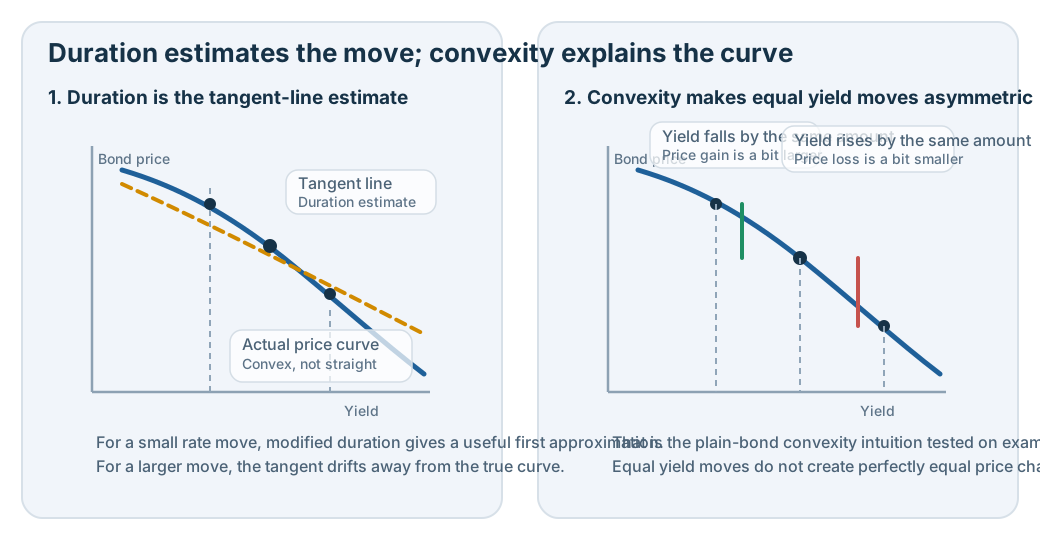
Duration is a first-order estimate. It assumes the price-yield relationship is roughly linear over small yield changes. In reality, the relationship is curved. That curvature is called convexity.
The practical exam idea is simple:
- duration gives the first approximation
- convexity explains why the approximation becomes less precise for larger yield moves
- for many plain bonds, price gains from falling yields are slightly larger than price losses from equal-sized yield increases
Students do not need advanced mathematics here. They need the shape logic.
Using the Properties Together
When comparing plain non-callable bonds, ask the following in order:
- Which bond has the longer maturity?
- Which bond has the lower coupon?
- Which bond is starting from the lower yield level?
- Which bond has the higher duration?
Those questions usually identify the more volatile bond before any calculator work begins.
Limits of the Simple Rules
These pricing properties are strongest for plain bonds. Results can change when the security has:
- call features that cap upside when yields fall
- credit-spread changes that move price independently of government rates
- floating coupons that reduce sensitivity to benchmark-rate moves
So duration and the usual pricing rules are powerful, but they are not universal explanations for every bond move.
Key Terms
- Price-yield relationship: Inverse relationship between bond price and required yield.
- Duration: Measure of price sensitivity to yield changes.
- Modified duration: Approximate percentage price change for a small change in yield.
- Convexity: Curvature in the price-yield relationship.
- Coupon effect: Lower coupon usually means greater price sensitivity.
Common Pitfalls
- Confusing duration with simple time to maturity.
- Forgetting that lower-coupon bonds are usually more volatile than higher-coupon bonds of similar term.
- Assuming the same yield change produces the same percentage price effect at all starting yield levels.
- Using duration as if credit spreads and embedded options do not exist.
- Treating the duration estimate as exact rather than approximate.
Key Takeaways
- Bond prices and yields move in opposite directions.
- Longer maturity and lower coupon usually increase price volatility.
- Lower starting yields often imply larger percentage price moves for the same change in yield.
- Duration is the main summary measure of interest-rate sensitivity.
- Convexity explains why the price-yield relationship is curved rather than perfectly linear.
Quiz
Sample Exam Question
Four non-callable bonds from the same issuer are otherwise similar except for the following features:
- Bond A: 3% coupon, 20 years to maturity
- Bond B: 7% coupon, 20 years to maturity
- Bond C: 3% coupon, 5 years to maturity
- Bond D: 7% coupon, 5 years to maturity
If market yields rise by the same amount, which bond should experience the greatest percentage price decline?
- A. Bond B
- B. Bond C
- C. Bond D
- D. Bond A
Correct answer: D.
Explanation: Bond A combines the two strongest drivers of price sensitivity: long maturity and low coupon. Bond B has the same maturity but a higher coupon, which lowers duration. Bond C has the same coupon as Bond A but much shorter maturity. Bond D has both shorter maturity and higher coupon, so it should be the least sensitive of the four.