Bond Price, Yield, and Discounting
How bond prices are calculated, how yield measures differ, how Treasury bill yields are quoted, and why reinvestment risk matters.
Bond pricing is the point where fixed-income terminology becomes usable. Students must be able to connect coupon rate, market yield, present value, discount trading, and realized return instead of treating them as separate definitions.
The exam often tests direction before arithmetic. If the required yield rises, price should fall. If a bond trades below par, its yield should usually exceed its coupon rate. If a quoted return measure assumes coupon reinvestment, reinvestment risk matters.
Bond Price Comes From Discounted Cash Flow
A plain fixed-rate bond is worth the present value of two sets of future cash flows:
- periodic coupon payments
- repayment of principal at maturity
At a high level:
The exact calculator method may vary with coupon frequency, but the idea does not change. The required yield determines how heavily future cash flows are discounted. Higher required yield means lower present value. Lower required yield means higher present value.
The Discount Rate Determines Fair Value
The discount rate used in bond pricing is not arbitrary. It reflects the return that the market currently requires for securities with similar:
- term to maturity
- credit quality
- liquidity
- embedded features such as call risk
This required return is often described as the bond’s market yield or yield to maturity.
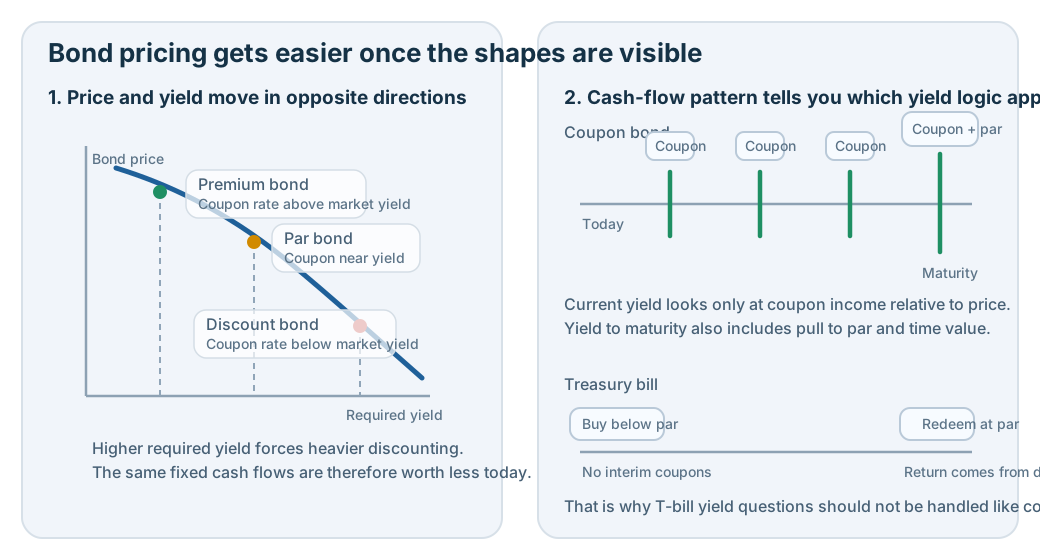
If the bond’s coupon rate is close to the required yield, the bond should trade near par. If the coupon rate is above the required yield, the bond usually trades at a premium. If the coupon rate is below the required yield, the bond usually trades at a discount.
Coupon Structure and Compounding Matter
Many Canadian bonds pay interest semi-annually rather than annually. That affects the mechanics of discounting because the investor receives two coupon payments per year and the yield must be applied on the same periodic basis.
Students do not need to treat this as a separate theory. The practical rule is simpler:
- match the cash-flow frequency to the discounting frequency
- compare quoted yields only after making sure the conventions are consistent
A pricing question becomes easier once the student first identifies whether the security is:
- a coupon bond with regular interim cash flows
- a zero-coupon or strip bond with no periodic coupon
- a money market instrument sold at a discount to maturity value
Current Yield, Yield to Maturity, and Related Measures
Several yield measures appear in fixed-income questions. They are related, but they are not interchangeable.
Current Yield
Current yield measures annual coupon income relative to current market price:
It is quick, but incomplete. It ignores time to maturity and any gain or loss from the bond moving toward par.
Yield to Maturity
Yield to maturity, or YTM, is broader. It reflects:
- coupon income
- the price paid today
- the bond’s maturity value
- the time value of money
YTM is the market’s internal-rate-of-return style measure for a plain bond held to maturity, assuming interim coupons can be reinvested at the same yield.
Yield to Call or Yield to Worst
If a bond can be redeemed early, the investor may also look at yield to call or yield to worst. The exam point is that embedded features can change the expected holding period and the most realistic return measure.
Treasury Bills Use a Discount Approach
Treasury bills do not pay periodic coupons. They are short-term Government of Canada obligations sold at a discount and redeemed at par.
A common annualized yield expression is:
The important distinction is that the investor’s return comes from the difference between purchase price and maturity value, not from interim coupon payments.
This is why Treasury bill pricing questions should not be treated like coupon-bond YTM questions.
Reinvestment Risk Affects Realized Return
Students often memorize YTM without noticing its main assumption: interim coupon payments can be reinvested at the same rate used in the yield calculation.
That creates reinvestment risk. If rates fall after purchase:
- coupon payments may be reinvested at lower rates
- realized return may end up below the original YTM estimate
This risk is usually greater when the investor receives more cash before maturity. A zero-coupon bond held to maturity has no coupon reinvestment risk because it does not distribute interim coupon payments.
Reinvestment risk also helps explain why callable bonds can disappoint investors when rates fall. The issuer may redeem the bond early just when reinvestment opportunities have become less attractive.
Interpreting Price and Yield Before Calculating
Strong exam performance usually starts with directional logic:
- if required yield rises, price should fall
- if a bond trades below par, its YTM should usually exceed its coupon rate
- if a bond trades above par, its YTM should usually be below its coupon rate
- if a security has no coupons, reinvestment risk from coupon cash flows is minimal
The arithmetic then becomes a confirmation step rather than a guess.
Key Terms
- Present value: Current value of future bond cash flows discounted at the required yield.
- Current yield: Annual coupon income divided by current market price.
- Yield to maturity: Return measure that incorporates coupon income, price, time, and maturity value.
- Treasury bill: Short-term government instrument sold at a discount and redeemed at par.
- Reinvestment risk: Risk that interim cash flows will be reinvested at a less favourable rate.
Common Pitfalls
- Treating coupon rate and yield as identical.
- Forgetting that YTM assumes reinvestment of coupon cash flows.
- Using a coupon-bond formula for a Treasury bill.
- Ignoring coupon frequency when pricing a semi-annual bond.
- Assuming a premium bond automatically offers the higher return.
Key Takeaways
- Bond price is the present value of coupon and principal cash flows.
- Required yield reflects market conditions for comparable risk and term.
- Current yield and yield to maturity answer different questions.
- Treasury bill returns come from discounting, not coupon income.
- Reinvestment risk means realized return can differ from quoted YTM.
Quiz
Sample Exam Question
An investor buys a non-callable bond with a $1,000 par value, a 4% annual coupon, and a market price of $970. The investor intends to hold the bond to maturity.
Which statement is most accurate?
- A. The bond’s current yield must be below 4% because the price is below par.
- B. The bond’s yield to maturity must equal 4% because the coupon rate is fixed.
- C. The bond’s yield to maturity should be above its current yield because the investor also expects pull to par if the bond is held to maturity.
- D. The bond must be overpriced because discount bonds always have lower total return than par bonds.
Correct answer: C.
Explanation: A bond bought below par offers not only coupon income but also capital appreciation as it moves toward par at maturity, assuming no default. That usually makes YTM greater than current yield. Choice A reverses the current-yield relationship. Choice B confuses coupon rate with YTM. Choice D makes an unsupported claim about relative return.