Asset-Backed Securities and Securitization
Asset-backed securities, including securitization, tranches, Canadian mortgage-backed examples, and the main credit, prepayment, and complexity risks.
Asset-backed securities, or ABS, transform pools of loans or receivables into tradable securities. Instead of lending to one borrower directly, the investor buys a security supported by cash flows from many borrowers or many contractual payment streams. This is the chapter’s most capital-markets-oriented structured product because the structure is built around securitization and tranche design rather than around retail principal protection.
The main CSC challenge is to separate the idea of securitization from the quality of any specific issue. Some ABS are government-supported mortgage structures with very high credit quality. Others are complex private structures whose performance depends heavily on defaults, prepayments, correlations, and the effectiveness of credit enhancement.
    flowchart LR
	    A[Borrowers make loan payments] --> B[Pool of mortgages, loans, or receivables]
	    B --> C[Special purpose vehicle or trust]
	    C --> D[Senior tranche]
	    C --> E[Mezzanine tranche]
	    C --> F[Residual or junior tranche]
	    D --> G[Investors receive cash flows by priority]
	    E --> G
	    F --> G
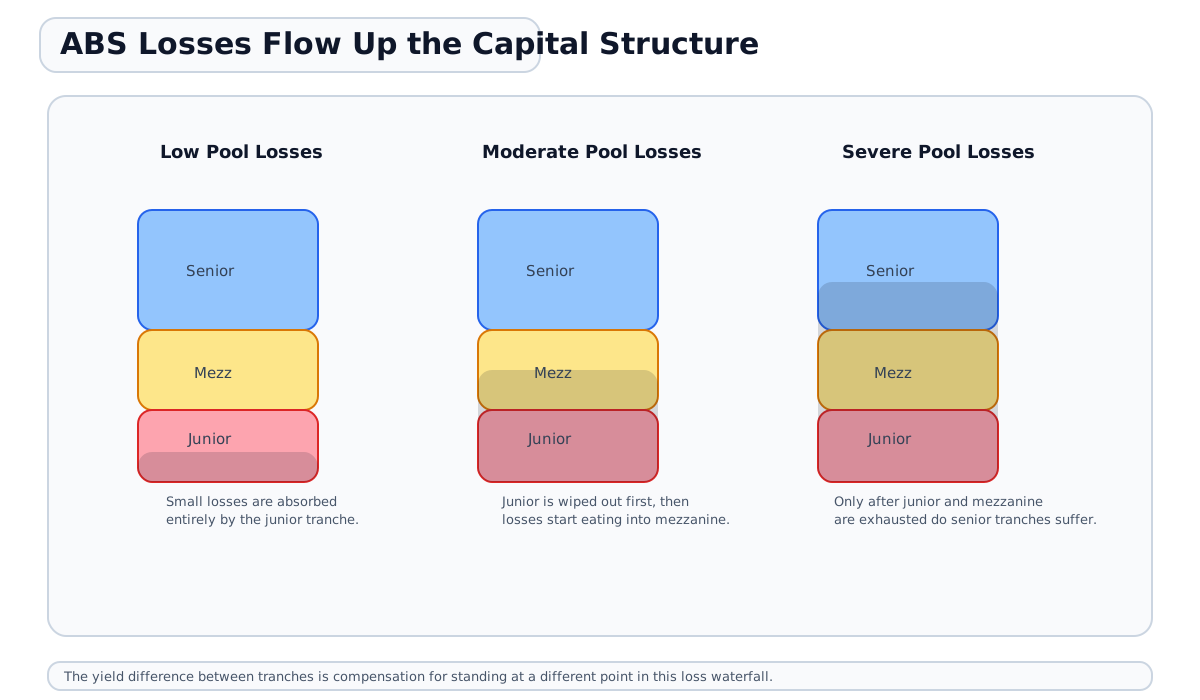
The securitization flow explains the issuance process. The stronger exam intuition is the loss waterfall: junior tranches are hit first, then mezzanine, and only later the senior tranche.
Start with the Securitization Process
Securitization turns illiquid financial assets into marketable securities. The usual steps are:
- loans or receivables are originated
- a pool of those assets is gathered
- the pool is transferred to a trust or special purpose vehicle
- securities are issued against the cash flows from that pool
The pool may contain:
- residential mortgages
- auto loans
- credit card receivables
- commercial loans
- leases or other receivables
This structure gives investors access to diversified loan cash flow without owning each loan directly.
Why Tranching Matters
Many ABS issues divide cash flows into tranches with different priorities.
Senior Tranches
Senior tranches get paid first and therefore usually carry:
- the lowest yield among the structure’s tranches
- the strongest credit support
- the highest expected resilience to losses
Mezzanine and Junior Tranches
Subordinate tranches absorb losses before senior tranches. They therefore offer:
- higher yield
- greater risk of principal loss
- greater sensitivity to defaults and structural stress
This hierarchy is a central exam concept. Higher priority usually means lower return potential but stronger protection.
Main Risks in ABS
Credit or Default Risk
Borrowers in the underlying pool may fail to make payments. If defaults rise high enough, the losses move through the structure from junior tranches toward senior tranches.
Prepayment Risk
Mortgage-backed and loan-backed securities can return principal sooner than expected if borrowers refinance or repay early. That can be harmful when the investor must reinvest at lower rates.
Extension Risk
The opposite can also happen. If expected prepayments slow, principal may stay outstanding longer than planned, extending the investor’s exposure.
Liquidity and Complexity Risk
Some ABS issues are difficult to trade and difficult to analyze. Complexity can hide exposure to assumptions about default timing, correlation, prepayments, or servicing quality.
Canadian Examples
Canadian students should know that the domestic securitization market includes both public-policy mortgage programs and private-credit structures.
NHA Mortgage-Backed Securities
CMHC’s NHA MBS program allows approved financial institutions to pool eligible insured mortgages into securities. CMHC provides a timely payment guarantee of interest and principal to NHA MBS investors. That makes these securities very different from ordinary private-label mortgage pools.
Canada Mortgage Bonds
Canada Mortgage Bonds are issued through the Canada Housing Trust and funded by pools of insured mortgages. CMHC states that they carry the full faith and credit of Canada, making them among the highest-credit-quality mortgage-related securities in the Canadian market.
Other ABS
Private or non-government structures can also securitize receivables such as auto loans, credit card balances, or commercial exposures. Those products need much more careful credit and structural analysis because they do not automatically carry government-style support.
Why Historical Caution Still Matters
The global financial crisis and the Canadian non-bank ABCP crisis showed that securitized structures can behave badly when investors underestimate liquidity and structural complexity. The lesson for CSC is not that all ABS are bad. The lesson is that the structure must be understood in detail, especially where the collateral, liquidity support, or payment waterfall is complicated.
Suitability
ABS are usually more relevant to institutional or advanced fixed-income analysis than to basic retail investing. When used, the strongest suitability analysis asks:
- What is the collateral?
- What credit enhancement exists?
- What is the tranche priority?
- How vulnerable is the issue to default, prepayment, or extension?
- How liquid is the security?
High-quality government-supported mortgage securitizations can play a very different role from lower-quality private ABS. Students should never treat the entire category as homogeneous.
Key Terms
- ABS: security backed by a pool of financial assets
- Securitization: process of converting pools of loans or receivables into tradable securities
- Tranche: class of securities with a defined payment priority and risk profile
- Prepayment risk: risk that borrowers repay earlier than expected
- Credit enhancement: structural support such as overcollateralization, excess spread, or guarantees that helps protect more senior investors
Common Pitfalls
- assuming all ABS have government backing
- ignoring the difference between senior and junior tranches
- focusing on yield without analyzing collateral quality and structure
- forgetting that prepayment can be harmful to investors
- treating complex securitization as if diversification alone removes risk
Key Takeaways
- ABS convert pools of loans or receivables into securities.
- Tranche priority is central to understanding risk and expected return.
- The main risks are credit, prepayment, extension, liquidity, and structural complexity.
- Canadian mortgage securitization includes high-quality CMHC-supported programs such as NHA MBS and Canada Mortgage Bonds.
- Not all ABS have the same support, transparency, or suitability.
Quiz
Sample Exam Question
A client compares a CMHC-supported NHA mortgage-backed security with a lower-rated private ABS backed by consumer receivables. He says both are just “bundles of loans,” so the higher-yield private ABS must be the better choice.
Which response is strongest?
- A. Agree, because ABS categories are interchangeable and yield alone should drive the decision
- B. Explain that the private ABS may carry materially greater credit, liquidity, and structural risk than a CMHC-supported mortgage security, so the higher yield is not a free advantage
- C. Agree, because mortgage-backed securities cannot have prepayment risk
- D. Explain that all ABS are guaranteed by the federal government
Correct answer: B.
Explanation: The client is ignoring the structural and credit differences between the two securities. Yield must be interpreted in light of collateral quality, guarantees, and the payment structure.