Market-Linked Guaranteed Investment Certificates
Market-linked GICs, including their deposit structure, return formulas, CDIC eligibility rules, and trade-offs versus PPNs and direct market investment.
Market-linked guaranteed investment certificates, often called market-linked GICs or index-linked GICs, are deposit products that guarantee repayment of principal while tying the interest or return to a market benchmark. They are often marketed to conservative investors who want some exposure to market upside without risking the deposited amount.
For CSC purposes, the key distinction is that a market-linked GIC is still a deposit. That makes it structurally different from a principal-protected note. The difference matters because CDIC coverage may apply to an eligible market-linked GIC issued by a CDIC member institution if the principal is fully repayable under the deposit rules.
    flowchart LR
	    A[Investor buys market-linked GIC] --> B[Deposit claim on issuer]
	    B --> C[Principal repayment at maturity]
	    B --> D[Return formula linked to index or basket]
	    D --> E[Participation, cap, or averaging]
	    B --> F[Possible CDIC eligibility if deposit rules are met]
The deposit structure matters legally, but the client comparison usually turns on the payoff shape: protected principal, limited upside, and weaker direct participation than equity ownership.
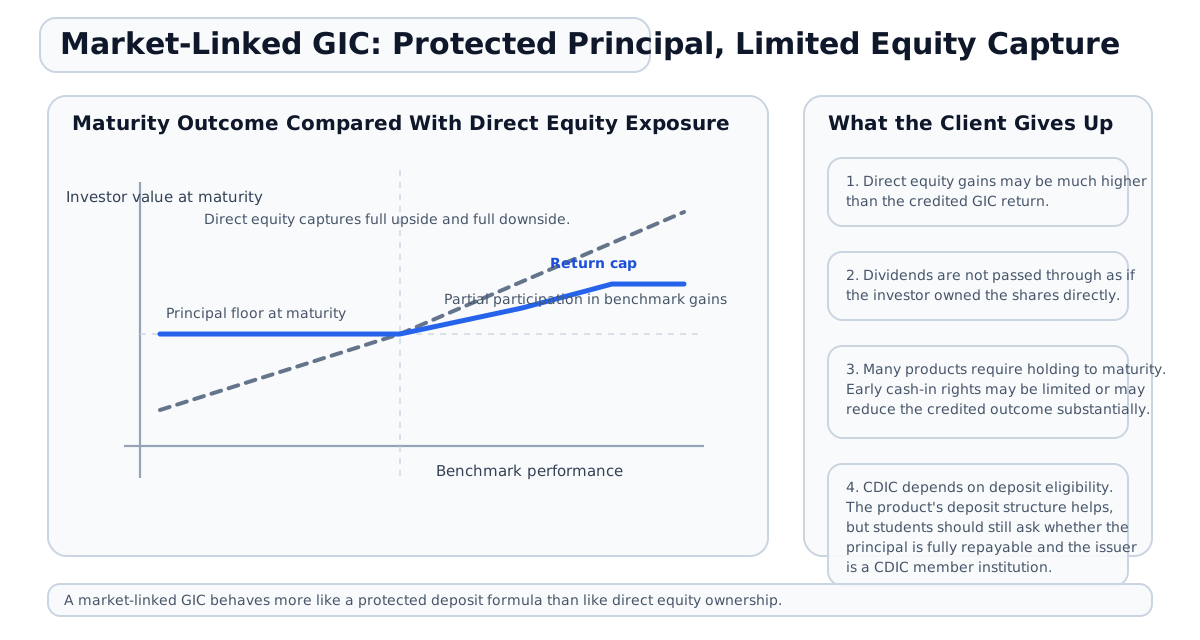
How a Market-Linked GIC Works
A market-linked GIC promises return of principal at maturity and offers variable interest based on the performance of a reference index or other benchmark. The investor is not buying the underlying shares directly. Instead, the issuer promises to calculate the payout using a formula.
That formula may include:
- a participation rate
- a return cap
- an averaging method
- a minimum interest amount, in some cases
If the reference benchmark performs poorly, the investor may receive only the principal back and no meaningful additional return.
The Deposit Structure Matters
Because a market-linked GIC is a deposit product, it should be analyzed through deposit rules rather than through note rules.
This leads to several practical consequences:
- the investor has a deposit claim against the issuer
- the product is usually simpler legally than a structured note
- CDIC coverage may apply if the issuer is a CDIC member and the deposit is otherwise eligible
Current CDIC guidance states that market-linked or index-linked term deposits are insurable only if the principal is fully repayable. Students should therefore avoid assuming that every product with “market-linked” in the name is automatically covered.
What the Investor Gives Up
Like a PPN, a market-linked GIC gives the investor principal safety at the cost of direct upside.
Common trade-offs include:
- no dividend income from the underlying equity market
- capped or partial participation
- no meaningful return if the market benchmark is flat or weak
- no intraday liquidity
- possible lock-in until maturity
This is why a market-linked GIC can be psychologically attractive but financially modest in many scenarios.
Liquidity and Redemption
Many market-linked GICs are non-redeemable before maturity. If redemption is permitted, the terms may include:
- penalties
- reduced credited return
- a net payout below what the investor expected
Current FCAC guidance on GICs and term deposits requires federally regulated institutions to disclose the term, repayment conditions, interest calculation, early-cash-in charges, and renewal rights clearly. This matters because some investors mistakenly think a market-linked GIC works like a plain cashable GIC. Often it does not.
Market-Linked GICs Versus PPNs
This is a core exam comparison.
Similarities
Both products may offer:
- principal protection at maturity
- upside tied to a market reference point
- limited direct participation in the underlying market
Differences
A market-linked GIC differs from a PPN because:
- it is a deposit, not a note
- CDIC coverage may be available if the deposit is eligible
- the product falls under the deposit and GIC framework rather than the PPN disclosure framework
That distinction is often more important than small wording differences in the sales brochure.
Suitability
Market-linked GICs may fit investors who:
- want principal safety
- can commit funds until maturity
- accept uncertain upside and possible zero additional return
- value deposit-product structure and possible CDIC eligibility
They are weaker fits for investors who need liquidity, want direct equity participation, or expect stock-like returns from a protected product.
Key Terms
- Market-linked GIC: GIC whose return depends on a market index or other reference point
- Index-linked deposit: another term for a market-linked deposit product
- Participation rate: percentage of benchmark gain credited to the investor
- Return cap: maximum return payable under the formula
- CDIC eligibility: whether the deposit qualifies for insurance coverage under CDIC rules
Common Pitfalls
- assuming the product is equivalent to direct equity exposure
- assuming a market-linked GIC always pays meaningful interest
- assuming all market-linked products are CDIC-insured
- overlooking non-redeemable terms and lock-in features
- confusing a market-linked GIC with a PPN because both mention principal protection
Key Takeaways
- A market-linked GIC is a deposit product with principal protection and formula-based market-linked return.
- The upside is usually limited by participation, caps, averaging, or all three.
- CDIC coverage may apply if the issuer is a member institution and the deposit is eligible.
- Many market-linked GICs must be held to maturity to achieve the intended result.
- The product is best for clients who value protection more than full upside participation.
Quiz
Sample Exam Question
A client wants principal protection and some exposure to equity-market performance. She also says that CDIC eligibility matters to her because she wants deposit-style protection if the issuer fails.
Which product is the stronger starting point?
- A. A principal-protected note, because notes are always CDIC-insured
- B. A market-linked GIC issued by a CDIC member institution, provided the deposit is eligible and the principal is fully repayable
- C. A split-share capital share, because leveraged equity exposure is safer than a deposit
- D. A closed-end fund, because exchange trading replaces deposit insurance
Correct answer: B.
Explanation: The client explicitly values deposit-style protection. A market-linked GIC is the stronger starting point because it is a deposit product, and CDIC coverage may apply if the eligibility conditions are met.