Overview of Structured Products and Payoffs
The main building blocks, payoff structures, risks, and suitability issues for structured products.
Structured products are investments whose payoff has been engineered rather than left to the straightforward return of a stock, bond, or ordinary deposit. The engineering may come from a derivative overlay, a deposit contract tied to an index, a note linked to a basket of assets, or a structure that splits one pool of assets into different risk classes.
For CSC purposes, students should resist the temptation to treat structured products as mysterious or automatically sophisticated. The strongest approach is to decompose each product into its building blocks and ask what the client is really buying: principal protection, capped upside, leverage, priority income, securitized cash flow, or some combination of those features.
    flowchart TD
	    A[Structured products] --> B[Deposit or bond component]
	    A --> C[Derivative or payoff overlay]
	    A --> D[Priority claims on cash flow]
	    B --> E[Principal protection or income base]
	    C --> F[Participation, cap, barrier, or leverage]
	    D --> G[Preferred versus residual claims]
	    A --> H[Examples in Chapter 23]
	    H --> I[PPNs]
	    H --> J[Market-linked GICs]
	    H --> K[Split shares]
	    H --> L[ABS]
The flowchart shows the building blocks. The SVG below shows why those blocks matter: they reshape the client’s outcome into a different payoff pattern.
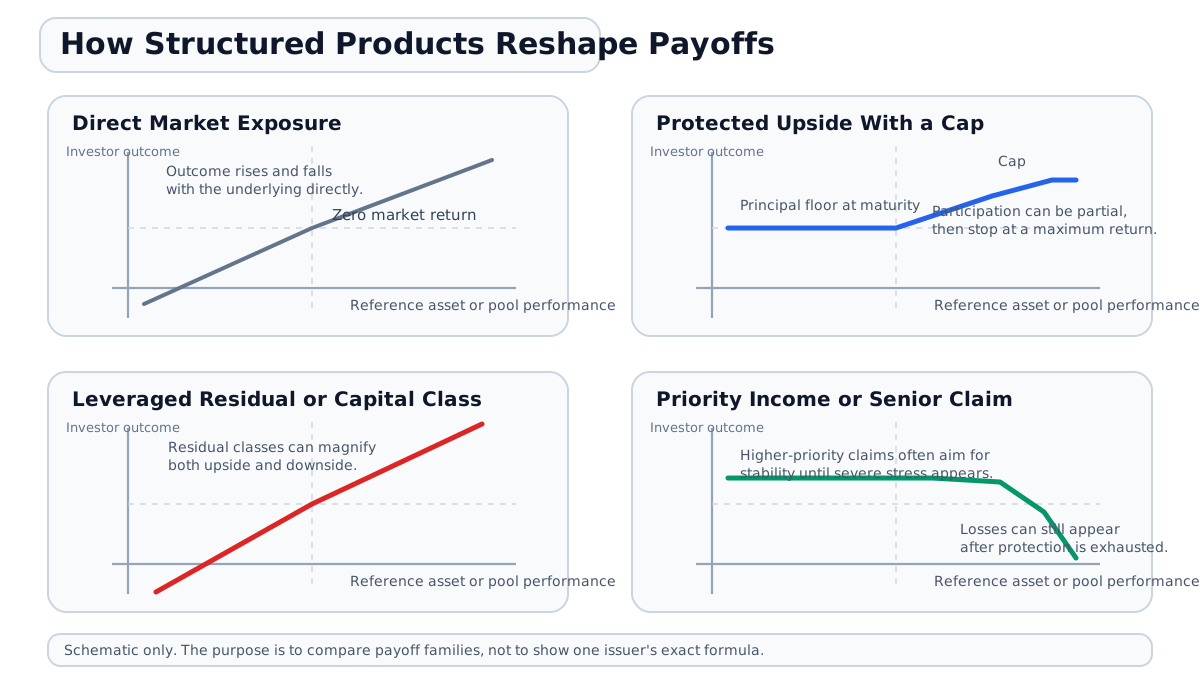
The Core Idea: Tailored Payoffs
A structured product usually starts with a familiar financial component and then modifies the outcome.
Common building blocks include:
- a deposit or bond-like component that supports principal repayment at maturity
- a derivative component that links the return to an index, basket, commodity, currency, or other reference point
- a cash-flow priority structure that divides one pool of assets into a safer class and a more leveraged residual class
Once students see those building blocks, many product labels become easier to understand. A principal-protected note and a market-linked GIC both aim to preserve principal while offering variable market-linked return. A split-share corporation divides one equity portfolio into income-focused preferred shares and leveraged capital shares. An asset-backed security converts loan payments into tradable securities with different tranches.
Why Investors Use Structured Products
Structured products are typically sold for one or more of these reasons:
- principal protection
- custom market exposure
- yield enhancement
- defined payoff limits
- access to exposures that would be difficult to build directly
These goals can be legitimate. For example, a conservative investor may want principal protection with some equity-linked upside. Another investor may want a high-income class backed by a specified pool of assets. The challenge is that the product’s headline feature often hides the real trade-offs.
The Main Product Features to Decode
When analyzing any structured product, students should identify the following terms clearly.
Reference Asset or Index
This is the asset, basket, or benchmark that drives the return. It may be:
- an equity index
- a basket of common shares
- a commodity benchmark
- a currency pair
- a pool of loans or receivables
Participation Rate
The participation rate tells the investor how much of the underlying gain will pass through. If the underlying rises by 20% and the participation rate is 70%, the product credits only 14%.
Cap, Floor, or Barrier
Some structured products limit gains with a cap. Others use a floor to guarantee a minimum result. Some use barriers that change the payoff if the reference asset crosses a threshold. These terms are not minor details. They usually determine whether the product is attractive or disappointing.
Maturity and Early-Exit Terms
A principal-protected feature almost always depends on holding the product to maturity. Selling early may expose the investor to market-value loss, liquidity constraints, or penalties.
The Main Risks
Students often focus too heavily on the upside story. The better approach is to classify risk.
Credit Risk
If the product is a note or deposit claim on an issuer, the issuer’s ability to pay matters. Principal protection is only as strong as the legal promise behind it and the applicable insurance or guarantee framework.
Opportunity Cost
A principal-protected structure often sacrifices direct upside. If the market performs very well, the investor may lag far behind a direct investment because of caps, low participation, or embedded fees.
Liquidity Risk
Many structured products are designed to be held to maturity. The secondary market may be thin, dealer-controlled, or effectively absent.
Complexity Risk
Complexity can make the payoff hard to compare with simpler alternatives. It also creates sales-practice risk because clients may focus on the marketed headline and miss the limiting terms.
Comparing the Main Chapter 23 Products
The chapter’s products can be grouped by the main risk they transform:
- PPNs: turn a note plus derivative into principal protection at maturity with market-linked upside
- market-linked GICs: use a deposit structure to offer protected principal with contingent return
- split shares: split one equity portfolio into a higher-priority income class and a leveraged residual class
- asset-backed securities: convert cash flows from loans or receivables into tradable securities with different risk tranches
That comparison is more useful than memorizing each product separately.
Suitability and Sales Discipline
Structured products should be recommended only when the structure solves a real client need. Good reasons might include:
- capital preservation with defined market participation
- a need for an income-oriented priority class
- institutional or advanced portfolio use of securitized credit exposure
Weak reasons include:
- the product sounds innovative
- the sales illustration highlights only a strong historical scenario
- the client was attracted by the word “protected” without understanding the conditions
Key Terms
- Structured product: investment whose payoff has been engineered using deposits, bonds, derivatives, or priority claims
- Participation rate: percentage of the underlying gain credited to the investor
- Cap: maximum return available under the payoff formula
- Liquidity risk: risk that the product cannot be sold quickly at a fair price before maturity
- Credit risk: risk that the issuer or obligor cannot fulfill the promised payments
Common Pitfalls
- assuming principal protection means the product has no risk
- ignoring caps, participation limits, or averaging methods
- forgetting that early sale may destroy the expected payoff
- comparing only the headline yield or protection feature instead of the total structure
- treating a complex product as automatically superior to a simpler one
Key Takeaways
- Structured products create customized payoffs by combining familiar financial building blocks.
- The key analytical tools are participation, caps, maturity, credit support, and liquidity.
- Principal protection usually applies only on stated terms, often at maturity rather than on early exit.
- Structured products solve specific client problems but often at the cost of simplicity or upside.
- A strong CSC answer explains the structure and the trade-off together.
Quiz
Sample Exam Question
A client asks why two products that both advertise principal protection can still be very different recommendations.
Which explanation is strongest?
- A. Because principal protection alone does not describe the issuer, the participation formula, the liquidity, the fees, or what happens if the product is sold before maturity
- B. Because any product with principal protection must deliver the same return
- C. Because structured products are regulated identically to common shares
- D. Because only split shares can offer principal protection
Correct answer: A.
Explanation: “Principal protection” is only one feature. The client’s outcome also depends on the product’s structure, issuer support, return limits, liquidity, and holding period.