Split Share Structures
Split shares as preferred-share and capital-share claims on one portfolio, with leverage, coverage, term, and suitability differences.
Split-share structures divide one underlying portfolio into two different claims. One class, usually the preferred shares, gets priority for dividends and repayment. The other class, usually the capital shares, gets the residual upside and bears most of the downside. The result is one pool of assets supporting two very different risk-return profiles.
That is why split shares belong in the structured-product chapter. The structure is doing the work. It is transforming an ordinary stock portfolio into a lower-volatility income class and a higher-volatility leveraged equity class.
    flowchart TD
	    A[Underlying portfolio of common shares] --> B[Split-share corporation]
	    B --> C[Preferred shares]
	    B --> D[Capital shares]
	    C --> E[Priority dividends and capital repayment]
	    D --> F[Residual gains and losses]
	    A --> G[Portfolio dividend and market risk]
The structure flow is helpful, but the stronger exam intuition is the claim waterfall. Preferred shareholders are paid first, and capital shareholders receive only what is left after that priority claim is satisfied.
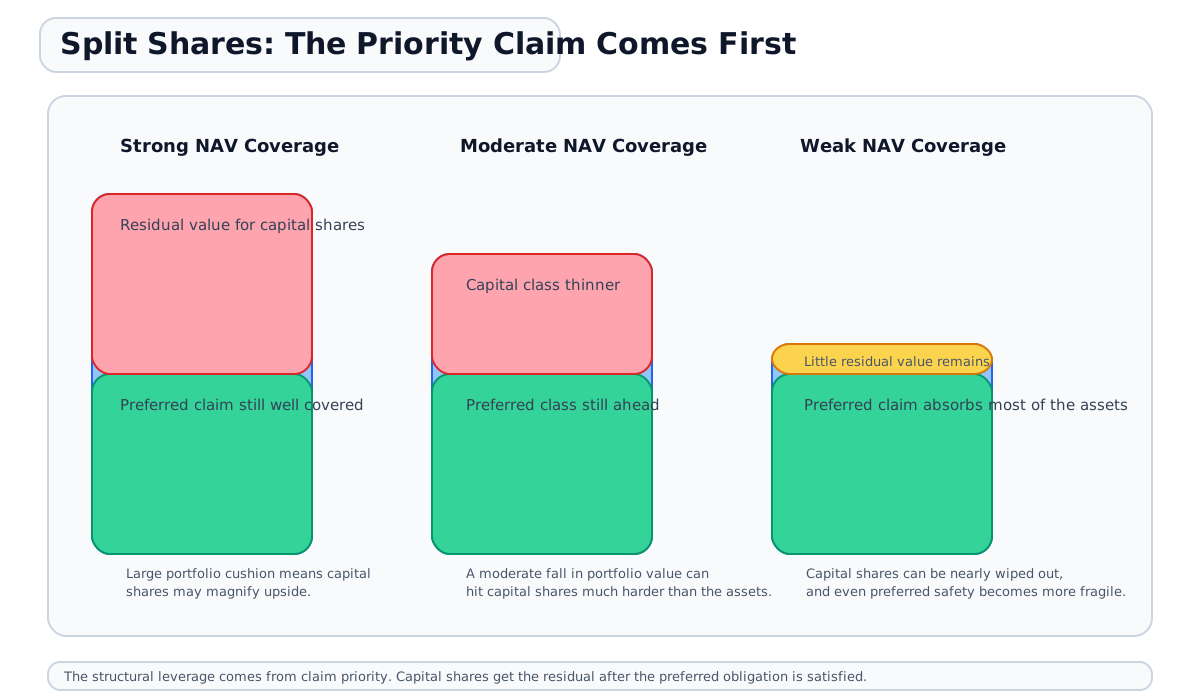
How the Structure Works
A split-share corporation typically holds a portfolio of dividend-paying common shares, often concentrated in large Canadian issuers such as banks, utilities, pipelines, or other income-generating companies. It then issues two classes of securities against that same portfolio.
Preferred Shares
Preferred shareholders usually have:
- first claim on the portfolio’s income stream
- first claim on capital at wind-up or maturity, up to the stated amount
- a fixed or targeted distribution rate
- lower upside potential than capital shareholders
Capital Shares
Capital shareholders receive the residual economic interest after the preferred obligations are met. That means:
- they get most of the portfolio’s upside after the preferred claim is satisfied
- they absorb most of the downside first
- they are much more volatile
This is why capital shares are often described as a leveraged way to own the underlying portfolio.
Why the Leverage Exists
The leverage in capital shares comes from priority, not from a margin loan in the investor’s own account. If the underlying portfolio performs well, capital shares can appreciate faster than the underlying shares. But if the portfolio falls, the capital share value can decline sharply because the preferred claim still sits ahead of it.
Students should therefore analyze capital shares as an equity-like claim with built-in structural leverage.
Income, Coverage, and NAV
The quality of a split-share structure depends heavily on the relationship between:
- the value of the underlying portfolio
- the preferred obligations
- the dividend flow from the portfolio
Two measures are especially important.
Net Asset Value Coverage
If the portfolio value is only slightly above the preferred-share obligations, the capital shares have little real protection. A decline in the portfolio can erode their value quickly and may also increase risk to preferred distributions.
Dividend Coverage
Preferred dividends depend on the portfolio’s income and the structure’s financing. If the underlying companies cut dividends or the portfolio is restructured poorly, the preferred share distribution can come under pressure.
Term and Wind-Up Risk
Many split-share corporations have a stated maturity or scheduled wind-up. At that point:
- the underlying portfolio is liquidated or otherwise valued
- the preferred shareholders are paid first up to their entitlement
- the capital shareholders receive the residual amount, if any
This makes time horizon important. A capital shareholder may be hurt not only by poor portfolio performance but also by weak NAV at the time of maturity or extension decisions.
Key Advantages and Drawbacks
Preferred Share Advantages
- higher-priority claim than capital shares
- income focus
- often lower volatility than the capital class
Preferred Share Drawbacks
- still exposed to portfolio and structural risk
- distributions are not government guaranteed
- interest rate conditions can affect valuation
Capital Share Advantages
- magnified upside if the underlying portfolio performs well
- access to a leveraged equity-style payoff without direct borrowing in the investor’s account
Capital Share Drawbacks
- significant downside sensitivity
- potential loss of most or all value if the portfolio weakens materially
- dependence on NAV coverage and term outcome
Suitability
Split-share products must be matched to the correct share class.
Preferred shares may fit investors who:
- want income
- understand that the product is still market-linked
- are comfortable analyzing coverage and portfolio quality
Capital shares may fit investors who:
- have high risk tolerance
- want leveraged exposure to the underlying portfolio
- understand that losses can be magnified by the structure
The weakest recommendation is to describe all split shares as conservative income products. Only the preferred class may have that profile, and even then the analysis must still include portfolio and coverage risk.
Key Terms
- Split-share corporation: corporation that issues preferred and capital shares against one portfolio
- Preferred shares: higher-priority class focused on income and capital repayment priority
- Capital shares: residual class with most of the upside and most of the downside
- NAV coverage: relationship between the portfolio value and the obligations to preferred shareholders
- Wind-up: maturity or termination event when preferred claims are paid before the residual amount goes to capital shares
Common Pitfalls
- treating preferred and capital shares as if they had similar risk
- assuming capital shares are just ordinary equity without leverage
- ignoring coverage ratios and portfolio concentration
- forgetting that term or wind-up matters
- assuming the preferred distribution is guaranteed in the same way as a deposit rate
Key Takeaways
- Split shares transform one portfolio into two different risk-return claims.
- Preferred shares have priority and are generally the lower-risk class.
- Capital shares are residual and behave like a leveraged equity claim.
- Coverage, portfolio quality, and maturity structure are central to analysis.
- The right recommendation depends on which class matches the client’s risk tolerance.
Quiz
Sample Exam Question
A client is considering split-share capital shares because the underlying portfolio contains large Canadian bank stocks. He says that because the underlying names are high quality, the capital shares should be almost as safe as owning the bank shares directly.
Which response is strongest?
- A. Agree, because capital shares always move less than the underlying portfolio
- B. Agree, because the preferred class absorbs most of the downside first
- C. Explain that capital shares are the residual claim and therefore usually behave like a leveraged position on the underlying portfolio
- D. Explain that capital shares are guaranteed if the split-share corporation reaches maturity
Correct answer: C.
Explanation: The capital shares do not have the safety of the preferred claim. They receive the residual outcome and therefore can be more volatile than the underlying portfolio itself.