Principal-Protected Notes in Canada
Principal-protected notes, including their bond-plus-derivative structure, issuer-credit risk, disclosure rights, and early-redemption limits.
Principal-protected notes, or PPNs, are notes whose return is linked to an index or other reference point, while the investor’s principal is promised back at maturity. They are among the clearest examples of a structured product because their payoff is intentionally built from separate pieces rather than from a direct investment in the underlying asset.
For CSC purposes, the most important point is that principal protection in a PPN is not the same as deposit insurance. A PPN is a note issued by a financial institution. The investor is relying on the issuer’s promise and the note terms. If the note is redeemed early, the investor may receive less than the original principal.
    flowchart LR
	    A[Investor buys PPN] --> B[Issuer]
	    B --> C[Bond or deposit-like funding component]
	    B --> D[Derivative linked to index or basket]
	    C --> E[Principal repayment at maturity]
	    D --> F[Variable return]
	    B --> G[Issuer credit risk]
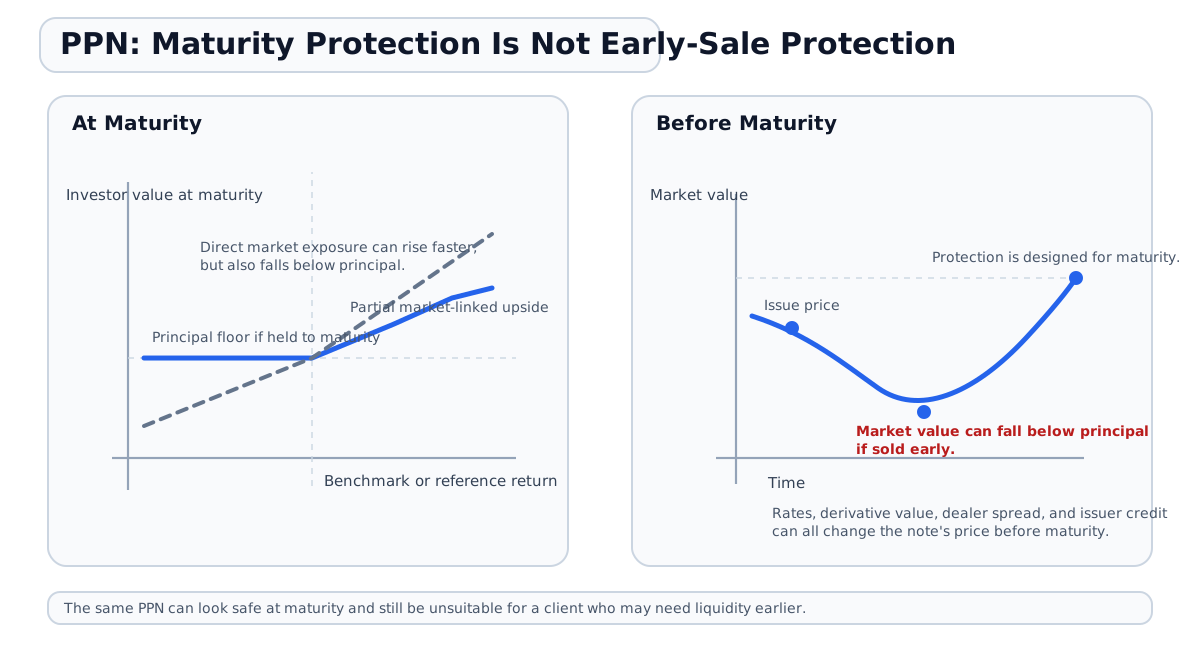
The structure flow is useful, but the stronger suitability question is geometric: protection applies at maturity, while resale value can move around before maturity.
How a PPN Is Built
The classic explanation is that the issuer uses most of the investor’s money to secure the principal repayment at maturity and uses the rest to buy derivatives linked to the chosen market exposure.
The derivative may reference:
- an equity index
- a basket of shares
- a commodity benchmark
- a currency pair
- another defined reference point
If the reference point performs well, the derivative component produces a gain. If it performs poorly, the investor generally receives only the principal back at maturity, assuming the issuer remains able to pay.
What the Protection Really Means
The phrase principal protected needs to be interpreted carefully.
It usually means:
- principal is protected at maturity
- protection depends on the issuer honoring the note
- the investor may still receive no positive return
- the investor may get less than principal if the note is sold early
This is why a PPN cannot be evaluated only by asking whether it protects principal. Students must also ask what upside is available and what conditions apply.
Current Canadian Disclosure Rights
In Canada, federally regulated financial institutions that sell PPNs must provide specific disclosure before the client buys the product. Current FCAC guidance states that they must disclose the required information in clear, simple, and not misleading language and, in the ordinary case, at least two days before entering into the agreement.
The required disclosure includes items such as:
- the term
- how and when principal is repaid
- how interest or return is calculated
- any charges and their impact
- the main risks
- whether the note can be redeemed early
- whether the investor may receive less than principal on early redemption
- whether the product is not insured by CDIC, if that is the case
That disclosure framework matters because PPNs are easy to misunderstand when the sales conversation focuses only on protection and market participation.
Return Limits and Hidden Opportunity Cost
A PPN often looks attractive to conservative investors because it promises principal protection with upside. However, the investor is usually giving up something meaningful:
- full direct participation in the underlying asset
- dividend income from the underlying shares
- liquidity
- pricing simplicity
The note may use one or more of these limiting features:
- low participation rate
- return cap
- averaging method that reduces credited gain
- long maturity
- embedded fees
A client can therefore end up with protected principal but disappointing total return relative to a simpler alternative.
Credit Risk and Early Redemption
The issuer’s credit quality is central. A PPN is only as secure as the institution behind it. If the issuer runs into serious trouble, the note’s protection can be impaired.
Early redemption is another major risk. The note’s secondary-market value may reflect:
- current interest rates
- remaining term
- derivative value
- dealer spread
- issuer credit spread
That means the note can trade below the original issue price even if the stated maturity promise remains intact.
PPNs Versus Market-Linked GICs
Students often confuse PPNs with market-linked GICs because both can promise principal protection with variable upside. The main distinction is structural:
- a PPN is a note
- a market-linked GIC is a deposit product
That difference matters for disclosure, insurance eligibility, and the legal nature of the investor’s claim.
Suitability
PPNs may fit investors who:
- want defined maturity-date principal protection
- understand that the upside is limited or conditional
- can hold to maturity
- are comfortable evaluating issuer quality and note terms
They are weaker choices for investors who need liquidity, want transparent pricing, or assume “principal protected” means “risk free.”
Key Terms
- PPN: principal-protected note linked to an index or reference point
- Reference point: benchmark or asset used to calculate the return
- Participation rate: share of the underlying gain credited to the investor
- Issuer credit risk: risk that the institution issuing the note cannot perform its payment obligations
- Secondary-market risk: risk that the note’s value before maturity is below the issue price
Common Pitfalls
- confusing principal protection at maturity with guaranteed positive return
- assuming a PPN is the same as a CDIC-insured deposit
- ignoring caps, averaging methods, or low participation rates
- forgetting that early redemption may produce a loss
- focusing only on the underlying asset and not on the issuer
Key Takeaways
- PPNs combine a promise of principal repayment at maturity with a variable market-linked payoff.
- The protection depends on the note terms and the issuer’s ability to pay.
- Current Canadian rules require clear pre-sale disclosure, usually at least two days before purchase.
- Early redemption can produce less than principal even if maturity protection exists.
- A PPN should be compared with simpler alternatives, not just with worst-case market fear.
Quiz
Sample Exam Question
A client is considering a principal-protected note linked to an equity index. He says, “Because the note is principal protected, I can sell it in two years without worrying about loss.”
Which response is strongest?
- A. Agree, because principal protection applies at all times after purchase
- B. Explain that the protection usually applies at maturity, so selling early may result in less than the original principal
- C. Explain that early-sale value cannot be disclosed
- D. Agree, because all PPNs are insured deposits
Correct answer: B.
Explanation: The client’s mistake is assuming that maturity protection and interim market value are the same thing. They are not. Early exit can expose the client to a lower market value.